New Staging Date
The new staging event is scheduled for June 24-25 in Washington D.C. I pray this will be the last delay in what has become a very testing experience to begin Peace Corps.
I received a call from Peace Corps yesterday and was informed that my program departure is being moved back a few weeks due to a logistical problem.
A lot has changed since my adventures in Madagascar ended and now I would like to introduce you to the new style of my blog.
The new title still seems a bit odd and I haven't got used to it yet. Tata Duhendeh is a mythical short man who lives in the bush, his feet are backwards and he has no thumbs. In folklore, the Belizeans say he is a forest guardian and trickster. He will punish people for over-hunting, taking Mayan artifacts, or causing mischief in the bush. However, Tata Duhendeh is not portrayed as an evil character, he will rescue people in the forest or teach you to play guitar as a reward.
For frequent visitors or anyone interested about updates on this page, I have added a tracking feature called Blogarithm. By clicking on the Blogarithm button, located in the right column you will be directed to a new page. Enter your email address and click. After a simple, two-step process to confirm your email address and select a password, the subscription is complete. You will receive an email when a new post is published. Much easier than bookmarks and you won't have to waste time checking the page to find nothing new.
Finally, I have added web-links to great sites with information related to Belize. Enjoy the new site and feel free to leave comments or suggestions.
The United Nations proclaimed May 22 The International Day for Biological Diversity (IBD) to increase understanding and awareness of biodiversity issues. This year The Convention on Biodiversity is promoting the protection of biodiversity in drylands.
In addition to an official celebration of International Biodiversity Day in Belize, organizations within Belize are putting on the 2nd Annual Natural Resources and Environment Week, May 21st to 27th. This year's theme is "Environmental Education- A Step Towards Friendly Development".
And that's where I come in, serving as an Environmental Educator. I will be helping Belizeans to manage natural resources and protect biodiversity in sustainable ways that accrue benefits to community members and improve their quality of life. It sound like a lot of responsibility, but I will take small steps and at the same time learn about the environment from Belizeans. Together we will make the world a better place.

Some facts and information about Belize...
Capital: Belmopan
Population: 273,700
Land Area: 8,876 sq mi
National Bird: Keel-billed Toucan
National Animal: Baird's Tapir
National Flower: Black Orchid
National Tree: Mahogeny
Belize is located in Central America; bound by Mexico in the north, Guatemala on the west and south, and 174 miles of Carribean coastline on the east. The land area of the mainland and cayes is 8,867 square miles; roughly the size of Massachusetts. The population is estimated to be 273,700; comparable to the population of St. Paul, Minnesota. Massachusetts has about 6.5 million people. The ethnic groups include Creole, Garifuna, Mestizo, Spanish, Maya, English, Mennonite, Lebanese, Chinese, and East Indian. Belize was a British colony, formerly known as British Honduras. English is the official language; Creole and Spanish are also commonly spoken. Agriculture (sugar, citrus, and bananas), tourism, fisheries, and forestry play a major role in the economy of Belize.
With 40% of it's territory designated as protected areas, Belize has the highest percentage in the world. Belize has a wealth of natural resources, icluding pristine forests, coral reefs, natural monuments, archaeological reserves, private and public land and a diversity of fauna and flora. The are 51 parks and forest reserves, 8 recognized private protected areas and 9 archaeological reserves, 11 marine reserves, and 12 marine spawning agregations.
"From the soft adventure novice to the hard adventure enthusiast, Belize is a paradise on earth. Hike through exotic jungle trails... tube along an underground river... explore the brilliant depths of a magnificent barrier reef... Belize can satisfy the adventurer in all of us. Adventure into a land rich in natural beauty and steeped in the magic of its Maya past. Renowned for pristine waters, exotic marine and wildlife, lush, unspoiled landscapes, and superb diving, Belize is Mother Nature's Best Kept Secret. Natural and unspoiled, Belize is a haven for some of the planet's most exotic and endangered species. It has become a recognized leader in preservation and conservation, where nature reserves abound, and a fascinating population of birds, beasts, and marine life reside."
-BELIZE TOURIST BOARD (www.travelbelize.org)
Here's a brief description of the new assignment I received from Peace Corps.
Country: Belize
Program: Community Conservation
Job Title: Environmental Educator
Dates of Service: Aug. 4, 2006- Aug. 3, 2008
The goal of this project is to promote initiatives of Belizean community members and organizations for the conservation of land and natural resources. The project works with community members to find opportunities where conservation can be partnered with income-generating activities. The project also provides support in increasing environmental awareness through the development and implementation of environmental education, both formal and non-formal.
The Peace Corps was founded in 1961 by John F. Kennedy and is guided by three goals:
*To help the people of interested countries in meeting their needs for trained men and women.
*To help promote a better understanding of Americans on the part of the peoples served.
*To help promote a better understanding of other peoples on the part of all Americans.
Not long after I arrived to the training post in Madagascar I received a notice of medical seperation. If you want a longer explanation and did not receive my email let me know. Before leaving Madagascar I captured some great photos, although it is simply a representation of everyday life in Madagascar. Time was so short that I did not have an opportunity to explore protected areas, to see lemurs, or anything of really wild nature. Now I am waiting patiently for a new volunteer assignment from the Peace Corps, hopefully close enough to make a return visit to Madagascar possible in my future.
View from PC Training Center
Malagasy woman doing laundry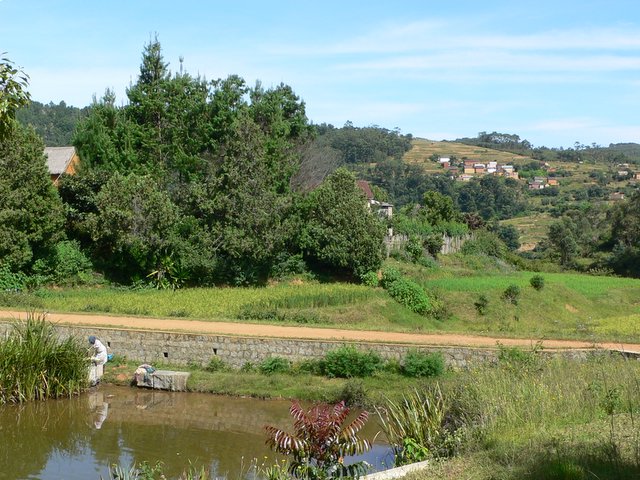
Terraced agricultural landscape.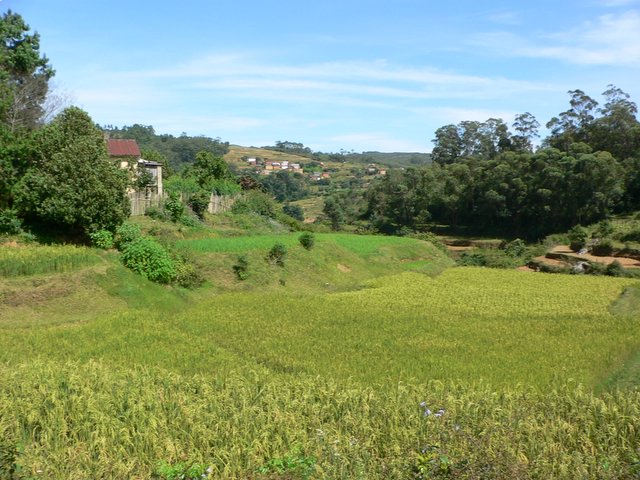
Comet orchid (Angraecum sesquipedale)

Staging in Phili is done. Shortly I will be going to the airport and flying to Africa. I am one of 21 new Volunteers who will be working on the Environment Project in Madagascar. During the 3 month training session I will have no Internet access, so it will be a while before I will be able to provide any updates.
The Wildlife Conservation Society (WCS) recently announced the establishment of a new protected area in Madagascar. To read the full article and for more information visit the following sites:
www.wcs.org/353624/madagascarsnewprotectedarea
www.wcs.org/international/Africa/madagascar/makira
For me this new found information has provided a better understanding of my duties as a Peace Corps Volunteer. Until now my assignment as a Protected Areas Management Volunteer seemed a little vague. The idea of working on natural resource management activities in rural communities near protected areas has left me wondering about the innumerable possibilities I could face in the future. It is encouraging to see a concrete example of protected area management in Madagascar that is in line with my assignment and how it will benefit both the community and natural resources. The site will be co-managed by WCS and the Ministry of Environment, Water and Forests (MINEF). As a PCV my primary duty is to meet the needs of MINEF and other partner organizations. The new Protected Areas System was designed to involve local communities in natural resource management.
Whether or not I will be assigned to work in this particular area of Madagascar, I don't know. Makira Protected Area is one of five newly established protected areas, with more sure to follow. President of Madagascar Marc Ravalomanana has committed to increasing the total area protected from 1.7 million to six million hectares by 2008.
Here some details from the assignment booklet I recieved and additional comments on the environmental health of Madagascar
Country: Madagascar
Program: Environment Project
Job Title: Protected Areas Management Volunteer
Dates of Service: April 2006-May 2008
The first Peace Corps program in Madagascar began in 1993 and to this date 514 volunteers have served there. The environment sector was established in 1994 with the following goals,
to reduce degradation of natural resources, develop capacity of local individuals and institutions, and enhance management capabilities of responsible government officials and non-government organizations.
Madagascar is one of the world's top hotspots for biodiversity, In Madagascar 80% of the plants and animals are endemic, that is they are found nowhere else on earth.
To qualify as a hotspot, a region must meet two strict criteria: it must contain at least 1,500 species of vascular plants (> 0.5 percent of the world’s total) as endemics, and it has to have lost at least 70 percent of its original habitat (www.biodiversityhotspots.org).
While Madagascar is one of the world's richest areas of biodiversity, economically it is one of the poorest. It is primarily an agrarian society where "nearly 80% of the original forestland has been converted into agriculture land." Environmental degradation has resulted from unsustainable agricultural practices, such as slash and burn agriculture practiced by rice farmers, which lead to deforestation, soil erosion, and decreased fertility.
Currently Madagascar has 46 protected areas which are managed by the Association Nationale pour la Gestion des Aires Protégées (ANGAP) and the Ministère des Eaux et Forêts (MINEF). ANGAP is the National Park Service equivelent, whereas MINEF is more like the USDA-Forest Service, which allows sustainable resource use. However, the goal of the MINEF is to allow the local communities to manage their resources.
I've created this blog in hopes of keeping family and friends updated on my adventures in Madagasar, where I have been invited to serve as a Protected Areas Management Volunteer for the Peace Corps. It all sounds good in theory, but I don't know how often I will be able to access the internet to update this site. Even if its one posting per month, I think the result will be more efficient and organized than mailing letters home.
If you have any questions realated to Madagascar and my journal entries please post them under the comments and I will respond. You may also contact me by email at scott_w_schmidt@yahoo.com.
"Ho eny Madagasikara aho" is the Malagasy phrase for "I'm going to Madagascar." A good reference site is http://www.wildmadagascar.org/.


