Thursday, May 24

Crooked Tree

The month of May was an exciting time for Crooked Tree. The first week of May a Cashew Festival is celebrated by Crooked Tree Village. Before I came to Belize, I only new about the cashew nut, which I assumed grew on a tree like other nuts. However, a cashew has a fleshy fruit, and the nut hangs outside of the fruit.

Belizeans also call it the "devil's fruit" because the raw shell contains a poisonous oil that causes skin irritation. Cashew belongs to the family Anacardiaceae, which includes Poison Ivy, Poison Oak, and Poison Sumac.

The ripe fruit or cashew apple is yellow to orange-red in color and can be eaten raw. Its surprisingly juicy and a bit tart. There are many ways to prepare cashew- cashew wine, cashew jam, stewed cashews, cashew syrup, cashew fudge, cashew nuts, cashew...


During May, Belize also experiences dry season, evident in Crooked Tree by the cracking mud flats surrounding the shrunken lagoon and vultures feeding on dead fish that have washed to shore (mostly tilapia, which are non-native to Belize). This caused quite a stir in the news.


(News 5 story) Fish kill around Crooked Tree has residents concerned

When the lagoon shrinks the fish also become more concentrated, which attracts a large amount of wading birds. I joined a group of birding enthusiasts for a day at Crooked Tree Wildlife Sanctuary. The amount of Wood Storks flying overhead reminded me of a fall day in Minnesota with flocks of Canada Geese filling the morning sky. Scanning through the birds with our binoculars we saw Jabirus, Great Egrets, Roseate Spoonbills, Black-bellied Whistling Ducks, and many more. "Find me a Great Blue Heron," said the man who was compiling our trip list. It was like Where's Waldo except we couldn't be sure that the bird was even existed in our field of view. I was happy to spot it first.


Friday, May 18

Go Nuts!

I ventured up the Old Northern Highway with a group of Volunteers to Lucky Strike Village. Nearby is the most visited Maya site in Belize, Altun Ha, which means "water of the rocks." From the Temple of the Sun God we enjoyed a beautiful Belize sunset.


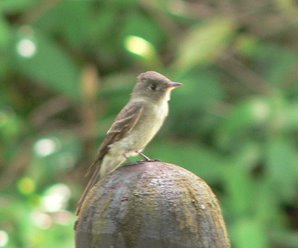
On Sunday I was woken up by the morning chorus of birds. The sun was just peaking above the trees and glowing like red ember. My bird I.D. skills are pretty good now, I know quite a few birds by sight and sound. I added two new birds to my checklist for Belize. The best find for me was a small group of Cedar Waxwings. First I heard the familiar high-pitched whistle and sure enough they were right above me. Cedar Waxwings are an irregular winter visitor in Belize, some years they are not seen at all. The bird pictured below is a Clay-colored Robin, which has a beautiful song.


Our team, the Gibnuts, didn't show up in full force this weekend so we played a 9-on-9 football game against Lucky Strike. Off to good start, we didn't give up any early goals. However, Lucky Strike scored 2 or 3 three goals before the Gibnuts roared back. I got a short pass from my teammate and was face-to-face with the opposing goalie. I booted the ball with left foot and watched it curve around him into the goal. The second half was much like the first. We gave a few goals and took one for our team. Lucky Strike hit the magic number, scoring 7 goals against the Gibnuts 2. Better luck next time. Go Nuts!


Thursday, April 19

Earth Day!

The Belize Audubon Society participated in the 2007 Earth Day Fair, (as pronounced in Kriol- Ert Day Faya) held at the University of Belize campus in Belmopan. Events included games, tree planting, music, and information booths. Elementary school classes and University students attended this all-day event.


Meanwhile, other staff members from BAS visited St. Herman's Blue Hole National Park, just south of Belmopan. One of the park wardens had seen some suspicious activity in the area and soon bags of xate leaves were discovered in the Park waiting to be picked up. A total of forty-one bundles, each with approximately thirty-six xate leaves, were collected and turned over to the Forest Department. Illegal xate harvest is a management frustration throughout Belize's protected areas.


This Sunday (April 22) you can tune in to Oapn Paki Show, were host Rosalie Stains will discuss issues with Belize Audubon Society's protected areas managers. The show airs live from 10:15am to 12:15pm on Love FM (you can listen to a live stream if you have Real Player).

Belize Audubon Society will continue to celebrate Earth Day throughout next week. Activities include classroom presentations and encouraging Belizeans to bike to work, school, or wherever they may go.

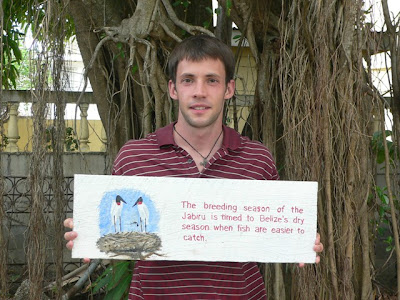
Often times I'm behind the lens of my camera, so family and friends at home haven't seen much of me since I left Minnesota. I'm alive and well, also wanted to show-off a project I have been working on lately. I took up oil-painting last week and completed ten signs that will make up an interpretive trail at Crooked Tree Wildlife Sanctuary. The Jabiru Stork (locally called Turk or Fillymingo) is a flagship species for wetlands in Belize. Crooked Tree Wildlife Sanctuary is recognized as a wetland of international importance under the Ramsar Convention on Wetlands.

Wednesday, April 11

Easter in Belize

The wind was howling and rain pounded on the zinc-top roof of my house Saturday morning. I had my alarm set early so that I could catch the first water taxi to Caye Caulker, but with the weather sounding like a hurricane I decided stayed in the soft comfort of my bed. Crowds of Belizeans travel offshore to the cayes to relax on the beach for the long Easter weekend. The weather man on the radio cautioned travel by small boats so I stayed in the city.

Instead I witnessed Belize's premier cycling event, the Annual Holy Saturday Cross Country Classic, a 140 mile bike race starting in Belize City, traveling west to San Ignacio where the cyclists turn around and ride back to Belize City for the finish. When I turned my radio on the race had just made the turn-around.
I rode my bike to the market to buy some fresh fruits and vegetables and also stopped to see if there was any activity at the fish market. I like seeing all the different kinds of fish that are brought in and the hungry bunch of Brown Pelicans in the canal waiting for scraps to be thrown to them. Fish prices go up in Belize like gas prices during Easter, the fishermen had already sold out. Normally $4-6 per pound, fish prices jump to $7-10 per pound at Easter.

As I listened in on my little radio, the leading pack had just left Hattieville and was about 12 miles outside of Belize City. Crowds of spectators slowly assembled along the race route as the cyclist came nearer. A group of men gathered under a shade tree next to me so they could hear the radio announcer while they enjoyed their One Barrel Rum and Sprite. Then came a motorcade of support vehicles, the media, and a police car, the cyclists were trailing right behind. The crowd cheered as the bikes went by in a flash and on to Marion Jones stadium for two laps around the track to the finish. In the final sprint it was American Boyd Johnson who came in first and in record time. The crowd was greatly disappointed that a Belizean did not win the race as predicted in the news. The top Belizean finish was fifth and for that he received a Brahma calf (not sure what the story is behind that). Boyd Johnson's victory was much like the surprise victory of Zach Johnson in the Masters at Augusta. I wonder if they are related?

Easter morning on my way to church I heard the excitement of children coming from one of homes in my neighborhood as they hunted for Easter eggs. I guess the Easter Bunny comes to Belize too. It was a beautiful morning, the lilacs are blossoming now. Afterwards, I visited a Peace Corps couple in the city to talk over coffee and a light brunch.

You may have noticed I made a few layout changes to my blog, I upgraded to the new Blogger. Not everything is displaying correctly, such as the weather, its been very hot in Belize this week, highs in the 90s and it broke 100 one day. I'm missing the cool breezes at night and had to turn on the fan instead. Also I would like to point out my YouTube link; I added a new video this week, this time I used video editing. You can watch it below.


Tuesday, March 27

Xaté Survey

Last week I worked with staff members from the Belize Audubon Society surveying diversity and density of xaté palms (family Chamaedorea) in Tapir Mountain Nature Reserve. The Reserve (6,750 acres) was designated to maintain natural processes in an undisturbed state, thus it is not open to the public. Despite management and patrol efforts, many illegal activities occur within its borders, such as logging and hunting. Most evident in Tapir Mountain Nature Reserve is the presence of xatéros, who work illegally in Belize collecting leaves that are trafficked back to Guatemala (trails marked with blaze orange arrows spray-painted on trees and cleanly chopped by machetes, clearings in the forest for make-shift camps, litter on the ground, and of course the xaté palms stripped of all their beauty).

Xaté (sha-tay) are leaves from three Chamaedorea palm species (C. elegans, C. oblongata and C. ernesti-augustii) used in the floral industry. They are used commercially because they are attractive leaves that can last for up to 45 days after being cut. This makes them popular for flower arrangements, Palm Sunday services and decoration. Make a difference by making sure that your flower arrangements come without xaté leaves or that the xaté leaves come from a sustainable source. There is currently very little sustainable fishtail available but this should be changing in the next few years as projects in Guatemala and Belize begin harvesting.
(read more)

-Belize Botanic Gardens

To develop capacity in Belize for conserving and sustainably managing xaté palms (Chamaedorea spp.) and improving economic benefits to Belizeans from xaté collection a collaborative venture between the Natural History Museum (London), the Belize Forest Department, and the Belize Botanic Gardens was established in 2003 through The Darwin Initiative. The Darwin Initiative is a small grants programme that aims to promote biodiversity conservation and sustainable use of resources around the world.

The fishtail palm (C. ernesti-augustii) is the most commonly harvested xaté species. We observed that xatéros had covered every square inch of the Reserve; steep terrain, thick bush, no matter- the xateros had already been here. Besides being illegal, xaté harvest in Belize's protected areas is done unsustainably; some plants were left with only a stem. After four days of surveying we only observed two mature fishtail palms with harvestable leaves that were completely unscathed.

What I found most interesting during the survey was a large and healthy fishtail palm with a hummingbird nest, neatly woven out of the spider silk, on one of its leaves. The typical fishtail palms we encountered stand about knee-high off of the ground, this palm was over my head. I don't think disturbed palms cannot grow high because they put so much energy into producing new leaves (it takes 2-3 years for the plant to mature).

What if this bird species (not sure which one, we only saw the nest) has a specific relationship with the fishtail palm? It could not survive in a disturbed habitat because its nest would be low to the ground and very susceptible to nest predation. Its a stretch, but who knows, nature has so many secrets that have yet to be discovered.

Thursday, March 15

La Ruta Maya Belize River Challenge

This year marked the 10th anniversary of La Ruta Maya Belize River Challenge, the longest canoe race in Central America. La Ruta Maya is a four-day canoe race along the Macal and Belize Rivers, once a major trading route of the Mayas. Starting in San Ignacio under the historic Hawksworth Bridge (the only suspension bridge in Belize), the race covers 170 miles before reaching the Belcan Bridge in Belize City. San Ignacio, in western Belize, was an important center for the Baymen (British loggers) and chicleros (collectors of chicle, which is used to make chewing gum), who also relied on the river to transport their goods.

“With the spirit of competition and the promise of high adventure, the challenge is hereby cast to any and all hardy souls throughout Belize and the world, who dare to take up the quest for victory and pursue the adventure of a lifetime on the Belize Old River.”

This year 93 teams, each consisting of three paddlers, competed for the adventure of a great race or a chance to the win “Kinich Ahau” Trophy among the serious competitors. Kinich Ahau (the sun god) is a national treasure that was discovered at the Altun Ha ruins in Belize, to date it is the largest jade carving found in any Maya country.


I had been prepared for the challenge mentally ever since last year when I first heard of the race during pre-service training. I registered a team (myself and two other Peace Corps Volunteers) but we still were without a canoe in late February. Thankfully, a co-worker from Belize Audubon Society was able to secure a canoe from a friend in Burrell Boom. And by good grace, another co-worker happened to have a meeting in Benque (just west of San Ignacio) the day before the race, otherwise we had no way of transporting the canoe. But that wasn't the last of our worries, before leaving Belize City I learned that one of my team members was sick and couldn't race. When I reached Cayo the news was confirmed, so we recruited a member from our support crew to fill the spot. At last the our team, Peace Corps Northmen, was complete. Northmen were voyageurs who had passed a winter in the North; also a reference to the Vikings (our team had two Minnesota natives and coincidentally our newest member once lived there).

March 9, 2007 (Day 1) San Ignacio to Banana Bank (49 miles)


We spent the night at another Volunteer's house and started carrying our canoe early before the race. It would have been very tiring, however we were able to hail a truck that was willing to help transport our canoe across town to the start of the race.


Under the stillness of a cool misty morning in the foothills of the Maya Mountains, the canoes packed behind the starting line anxious for the race to begin. The race was off in a mad dash, which caused a few canoes to turn over. We had a sturdy craft and were not worried about swamping. The lightweight racing canoes that had maintained their balance at the start flew down the river like an arrow, far out of sight. The competition slowly spread out and we settled into a pack of about five canoes.


Photo by PCV Jerry Wagner

Seated at the stern I navigated our canoe around the bends and through the rapids. The scenery along the river was beautiful - lush green forest, bird songs, parrots flocking overhead, howler monkeys calling in the distance. There are hardly any signs of development along the river - a few farms and small communities, families shouting words of encouragement to the racers, women doing laundry against the rocks, and children swimming.


It was a very long day that seemed to never end. We asked spectators how much further we had to go when it seemed like we were nearing the end; three miles we were told. About an hour later we got the same answer, three miles. Later someone shouted only 20 minutes to the Banana Bank, which also turned out to be an hour. Finally, we received a positive answer from a support boat, just 15 minutes. We sprinted towards the finish of stage one and soon heard bass booming music and the roaring crowd. Day one was over after paddling for 7 hours 20 minutes and 39 seconds.


A swim in the river was very refreshing at the end of the day.


March 10, 2007 (Day 2) Banana Bank to Bermudian Landing (60 miles)

Another early start and a rush of excitement at the line (pictured left: our team in the white canoe; that's me in the blue hat & black shirt; a big up toJerry Wagner for the photos). The second day of the race was the longest stage and required a lot of endurance. We got a good rhythm going and the cohesion of our team improved. Seeing rapids ahead was a welcoming sight to me. The weather was cool and it rained during parts of the day.


The highlight of the day for me was seeing a Central American River Otter sitting on the riverbank (only a few feet away as we passed by). I also identified birds for my teammates to help pass some time. We paddled along with another team of Peace Corps Volunteers for a while. Our dedicated support crew was waiting for us ahead and brought out much needed food and water. Our team re-charged with bananas, tortillas, peanut butter, Snickers, Gatorade, and lots of water.


On day two of La Ruta Maya we finished after 9 hours 25 minutes and 30 seconds.


March 11, 2007 (Day 3) Bermudian Landing to Burrell Boom (36 miles)


The start time was later in the morning and the extra hours of sleep were much needed. I had a good stretch before getting into the canoe, felt a little sore from the previous day but once I good my arms moving again I was feeling better. Lots of howler monkeys around Bermudian Landing (locally known as baboons). The river felt a slower, especially along the straight stretches of river. Starting to recognize the names of a few of the villages we passed. Day three finish- 5 hours 54 minutes and 45 seconds.


March 12, 2007 (Day 4) Burrell Boom to Belize City (25 miles)


The final day got off to a disappointing start. Seven minutes before the race a group the lead canoes made a false start because a person in the audience was blowing a whistle (even though the official starter was clearly shouting through a bullhorn how many minutes where left still the start time of 8:30am). We waited with a majority of the canoes as the officials tried to stop the race, eventually the starter shrugged his shoulders and said, "We can't stop them now." And off we went. After rounding the first bend a boat was cruising down river telling the teams to turn around for a re-start. We paddled back up river and waited in the shade as the rest of the canoes slowly returned, but not all of them. The official announced that the race would start again at 10:00am. I was very disappointed because I could tell the sun would be very hot. 10:00 and the 10:30 rolled around, still no sign of the leaders. Rumor was that they were getting towed back by a boat and needed recovery time. The race finally went off at 11:30AM.


We paddled hard on the final day and battled a strong headwind. Before reaching the sea the race course disappeared into a narrow canal. I felt like I was deep in the jungle, surrounded by mangroves. The canal widened after a few miles and we raced down the home stretch. I recognized buildings that I pass by on my way to work. After another mile the Belcan Bridge came into view. People along the banks of the canal were yelling for us to paddler faster. And at last we reached the finish line after about four hours of paddling. We had completed La Ruta Maya after four days, totaling 25 hours and 58 minutes sitting in our canoe. Our overall finish was 56th and 9th in the Mixed Division.


Tuesday, February 13

Belize Bandfest 2007

Marching bands from around the country lined up in Belize City on Saturday morning ready to compete in Band Fest 2007. About a dozen bands paraded from the Southside to Marion Jones stadium. Dressed in uniforms of all colors the bands stepped to punta-rock and salsa cadences. The upbeat mood really got the crowd involved.

The typical Belizean marching band consists of a colorguard with batons and a drumline; very few wind instruments if any. Music education does not have a strong presence in Belize yet, so most of the students cannot read sheet music and the drumlines play their own cadences. The few bands with a trumpet made some noise (not of musical quality).

St. Luke's Methodist Primary School of Belize City (last year's champion of Bandfest) added recorders to their band this year. Peace Corps Volunteers Grant and Annaliza Thomas have been working with the school's music program; they played 'When the Saints Go Marching In.'

Visiting bands from Guatemala and Honduras were also featured in the parade. Instituto Evangelico Bethel from Honduras was hailed as the number one marching band in Central America by the announcer. I think they sounded good, but not on the same level as the Marshall Tiger Marching Band (my high school marching band). Colegio Osorio Sandoval, from Guatemala was equally as good as the Honduran band.

Another great marching band to mention is the Stella Maris School -Belize Academy for the Deaf. They were a led by a banner that read "Futuristic Trendsetters Marching Band."

In the afternoon there was a field competition. The stadium was full and Prime Minister Said Musa was in attendance, while the bands stood in block formations for the opening ceremony. A bugle corps, Banda de Geurra, visiting from Mexico performed a traditional military-style show. After a few speeches the visiting bands played the national anthems for Honduras, Guatemala, and Mexico; Belize's national anthem was played by a DJ through the sound system. Shortly afterwards it started raining, which delayed the show for a while.

The marching band field competition is new to Belize, this being the second year of Bandfest. Each band was given fifteen minutes for their field performance. They appeared semi-rehearsed and I wasn't impressed with the marching. The drumlines stood in place a lot of the time while the colorguard did their dance routines until the announcer called the time.

A few of the schools put on a performance that resembled a field show. St. Luke's marched formations (including the letters S &L) and the drumline played in control so I could still hear the recorders from the stands. One my favorite performances of the day was Mt. Carmel Marching Band from Benque; their show started with Belize's National Anthem on bells. They went on to win first place in the Primary School Division and second overall.

The champion of the day was Succotz Festival Drum Corp (pictured below). Their show had a great Latin rhythm. Succotz, a small village in the Cayo District, has a great music teacher, many students with musical talent, and a lot of proud band parents. They had more than one band representing Succotz. I sat among the Succotz crowd in the stadium who were waving school pennants. I was radiant with glitter before the end of the show.
The visiting bands, which did not compete, also put on great field shows. Their brass sections were large and in charge; especially the trumpets (that's my kind of marching band). And just when everyone was ready to go home, Instituto Evangelico Bethel started playing Bob Marley tunes and the whole crowd got on their feet and sang along. Check out more of the action on my Flickr photo album.

Thursday, January 25

A Lighthouse Tale

An old weathered red and white lighthouse overlooks the blue lagoon at Half Moon Caye of Lighthouse Reef Atoll. The brick foundation is slowly crumbling into the waves and the sea salt has been eating away the steel frame. After reading a research paper on the cayes of Lighthouse Reef Atoll (Stoddart 1962), I discovered the history of this particular lighthouse.
The first lighthouse on Half Moon Caye was built in 1820 and was lit on December first of that year. The lighthouse was replaced in 1845 and built midway between the north and south sides of the caye. Hurricanes have actually moved the caye northward, now the lighthouse rests at the edge of the sea. The steel frame tower was built on the brick foundation in 1933.
There has been interest in preserving this historic landmark but no efforts due to limited funding. Based on my own observations, the old lighthouse is currently used by a pair of Ospreys as a nesting place.

Monday, January 22

Spaghetti and Dodgeball: A Recipe for Success

The Belize Triathlon Association hosted the 2nd Annual BTB (Belize Tourism Board) Challenge on Sunday, January 21. Prior to Sunday's races, Peace Corps Volunteers assembled for a dinner of spaghetti and garlic toast (the secret is in the sauce). While enjoying a carb-loaded meal, race participants received words of inspiration from the movie Dodgeball.

PCV Greg Szalay cycling ahead of the competition.

In the individual sprint competition (swim-750m? bike-20K run 5K) Peace Corps Volunteer Greg Szalay finished seconds behind Panamanian triathlete, Libardo Bru, whose winning time was 1:20:11.77. In the swimming leg of the race Bru was the first competitor out of the water and despite going off-course he recieved no time deduction. If Chuck Norris was judging the triathlon, clearly Szalay would have won. The sole racer in the female division, Jamie Lee Usher finished with a time of 1:29:32.58.

Individual sprint men's results: (1) Libardo Bru 1:20:11.77, (2) PCV Greg Szalay 1:20:44.52, (3) Kenneth Butler 1:25:55.49, (4) PCV Ness Tiano 1:35:58.85

In the corporate relay division, team BATSUP (British Army Training Support Belize Unit) claimed victory with a winning time of 1:18:26. Finishing in second place (1:26:54) were the Leopards, a team comprised of Peace Corps Volunteers. Swimmer Jenny Groenenboom gave the Leopards a strong starting position, exiting the sea in second place. Underdog cyclist, Jerry Wagner was the only competitor in the field racing a "power bike" (mountain bike). While drawing some laughs from spectators, Jerry and the Jagger endured the 20K bike ride only slipping two spots to the fierce competition. Minnesota-native Mike Norbeck, with a strong running performance, reclaimed the second place spot for the Leopards. The other Peace Corps Volunteer team in the division (swimmer Grant Galland, cyclist Audrey Spencer, and runner Erin McClellan) finished with a time of 1:43:46. PCV Rob Landolfi swam for team Belize Hotel Supply Ltd. Volunteers will donate their cash winnings towards Peace Corps projects.


(left) Jerry Wagner (Leopards) mounts the Jagger. (right) The Dyno Dips and Amphilife in a tight race.

Corporate relay results: (1) BATSUP 1:18:26, (2) (PCVs) Leopards 1:26:54, (3) Dyno Dips 1:28:12, (4) Amphilife 1:29:38, (5) Belize Hotel Supply Ltd. 1:32:04, (6) (PCVs) Zissou 1:43:46.

(left) Audrey and Erin in race mode for team Zissou. (right) 2nd place Leopards: Mike, Jenny, and Jerry with BTB reps.

Tuesday, January 9

PCV Cribs

As an Environment Volunteer in the Peace Corps, living in Belize's most populated city isn't exactly the most picturesque locale. People usually envision Volunteers living in something simple like thatch huts in the bush, which is the case for some of Belize's Peace Corps Volunteers. I want to big up the Rural Community Development Volunteers for the work they do. However, living in Belize City is a much different situation, I have indoor plumbing and electricity.

Welcome to my palace. Through the front doorway enter my spacious living room (still unfurnished) and you'll see a beautiful chandelier that looks like a million bucks (closer inspection will reveal its made of plastic, not crystal). The floor is tiled, the walls are blank and boring except for the curtains I recently put up.

Moving on, let's look at my kitchen, this is where all the magic happens; rice and beans, stew beans and white rice, stew chicken, flour tortillas, fry jacks, you name it, this little stove does the job. And until I get some actual cookware I'm relying on a Boy Scout mess kit for nearly all my cooking needs. On the counter, next to the stove I have a bottle of Marie Sharp's Habenero Pepper Sauce, everybody has got to have a bottle of this. Also, fresh pineapple and bananas from the local market. Bananas are going for "ten fi dala" in the market place. Everything is sold per dollar or per pound at the market (one U.S. dollar= two Belize dollars).

Here's the other half of the kitchen and everyone is probably wondering what's in the refridge? I'm keepn' it fresh; lots of vegetables from the market (cabbage, carrots, cucumbers, onions, tomatoes, sweet peppers, cilantro), limes, fresh squeezed orange juice, guava jelly, honey, eggs, and left-over rice and beans. Frozen chicken and ice cubes in the freezer. On top of the refridge is my radio, the DJ has a great selection of ten hits on replay all day and his voice interrupts the song every second or he plays annoying mix effects.

Next to the refridge I have a microwave and my Belize flag, have to big up my host country Belize. Below, in the cupboard I have some dry goods - rice, beans, flour, cane sugar, powdered milk, baking powder, cocoa, etc. But you haven't seen anything yet, check out my Crystal, five gallons of the finest quality purified water (Crystal is the name of the bottling company).

Here's my ride- the Jagger, 26 inch rims, Xtreme Tested Construction, this Golden Cycle was designed in the U.S.A. You'll notice I have a bicycle helmet because you know I always have to ride the Jagger in style (and so Peace Corps doesn't send me home, its in the Policy Manual).

Let's see the rest of the house. Here's the bathroom, the toilet flushes and it has a shower (it's cold and environmentally friendly, really helps me conserve water). When I first moved in I was greeted by a small snake that had crawled in through the shower drain and a house gecko. I hear the geckos chirping at night, but I don't mind as long as they keep the cockroaches out of my house. (House Geckos are an introduced species, brought over to control a crop pest I think, they've become a nuisance in many households)

Here's the master bedroom (and the only bedroom). It came with a built in closet. A big wardrobe wasn't big on my packing list so there's a lot of space in there. I "jres op" for church on Sunday, otherwise keep it pretty low key. I have quite a selection of books and a stack of Newsweeks to entertain my free time, currently reading a book about baseball's minor leagues. PCVs love to read and a good variety of books have been left behind by past Volunteers. I also store my Peace Corps issued Health Kit here, it collects a lot of dust (I haven't came down with any parasites, illness, or injuries). Mosquitoes are known to carry malaria in Belize so every Monday, "Malaria Monday!", I take a tablet. I get a nice breeze through my window at night so I can sleep easy, but lately I've been waking up to rain in the middle of the night. It's been an unseasonably wet winter in Belize (blame it on El Nino).


On the outside my house is a washed out pink color. I live in a safe and quiet family neighborhood. The kids get a little rowdy at times; last week one of the neighbors rented a trampoline for a birthday party and fireworks from Christmas and New Years are popular. I have "burglar bars" on all my windows, its pretty standard in the cities and towns of Belizw. I have a small coconut tree in my yard, some hibiscus shrubs, grass, and a line to dry my clothes. The Caribbean Sea is close by, but sadly its too polluted to swim in near the city. You've seen my crib, now get out of here before the House Gecko gets you.


Friday, December 22

Krismus deh rite rung di kaana!

Christmas is right around the corner. A few updates about what I've been doing lately. I went of a field trip to Half Moon Caye and Blue Hole Natural Monuments last Saturday. The Red-footed Boobies are nesting now and I went snorkeling around the edge of the Blue Hole. On Sunday, I participated in the Belize City area Christmas Bird Count. My group recorded 101 species. Highlights for me were Yucatan Jays (endemic), a great view of an Aplomado Falcon, and a Red-breasted Merganser (listed as an accidental species; I'm not sure how accurate this is but I believe it was the 3rd or 4th record for Belize). After Boxing Day is the Christmas Bird Count for the Belmopan area.

This week I took a trip to Maya Centre. I led a two-day computer training workshop for the Maya Centre Women's Group, teaching the basics of Microsoft Word and Excel. Mr. Genus and I had dinner with Paul (researcher from the U.K.) who arrived to Cockscomb recently; he will continue camera trap research on jaguars and try to collect hair samples for DNA analysis to better understand population density and dispersal patterns outside the park. The research cabin has no electricity, so we had a candlelight dinner of rice, beans, johnny cakes, and eggs. I spent the night in Cockscomb (it was dark by 6pm felt like much later), listening to crickets and howler monkeys (a nice change from the noise and traffic I hear in the city). Early in the morning I went birding and hiked two trails in Cockscomb. Along the Tiger Fern Trail I encountered this beautiful heliconia (the flower pictured above), I also encountered some peccaries, and fresh Ocelot tracks in the mud. Had a few rain showers, but the canopy serves as pretty good cover. Went back to Maya Centre in the afternoon and completed the computer training workshop. Back in Belize City now and looking forward to the long weekend. Merry Christmas!

Sunday, December 10

Belize Audubon Society Receives Grant From Jaguar Conservation Trust


Five grant recipients were recognized at the Belize Ford Grants - jaguar Conservation Trust Awards Ceremony, held in Belize City. Opening remarks were given by Bill Bowman, General Manager of the Belize Estate Company, the Ford dealership in Belize. This year's recipients of Ford Motor Company Conservation & Environmental Grants were the Belize Creole Museum & Gallery, Community Baboon Sanctuary Women's Conservation Group, and a community group from Benque Viejo del Carmen. Each project was awarded (US)$2,500.

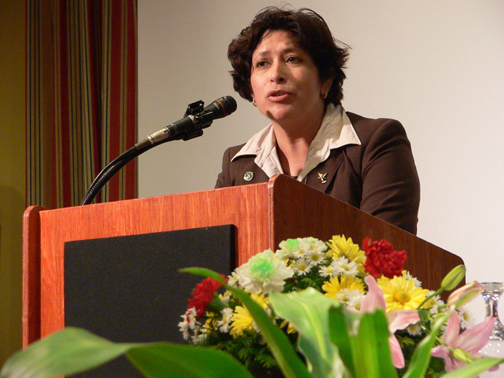
Protecting their namesake, Jaguar Cars (North America) established the Jaguar Conservation Trust to promote the preservation of the jaguar and its habitat. Actress, conservationist, and Jaguar Conservation Trust's lead consultant, Stefanie Powers presented grants to the Belize Audubon Society and Jaguar Shield. Jaguar Shield was awarded (US)$8,000, which will address problem jaguars in Belize. Accepting the award for the Belize Audubon Society was Executive Director Anna Dominguez-Hoare. The (US)$13,100 grant will be applied towards jaguar conservation and education at Cockscomb Basin Wildlife Sanctuary.

Friday, December 1

Youth and AIDS in the 21st Century

Heavy rains in Belize City did not stop bus-loads of youth from attending a World AIDS Day event. HIV/AIDS is an epidemic in Belize; the 2004 World Population Data Sheet indicates that outside of Africa, Belize has the sixth highest prevalence of HIV/AIDS in the world.

I heard about the event from a Peace Corps Volunteer who works with the Belize Red Cross. The Belize Red Cross was involved in the first national response and continues to participate in advocacy, providing information, training, technical assistance, food and clothing.
The Belize Red Cross, XChange/UNICEF, Ministry of Education, Youth for the Future, and National Art Development Foundation partnered with many other organizations organized a Youth Fest in Memorial Park. This year's theme:"Youth and AIDS in the 21st Century. Move On…". The Youth Fest featured performances from young people in the schools, youth organizations, and local musicians. All of the performances focused around the theme, to present positive messages, combat stigma and discrimination and disseminate accurate information about HIV and AIDS.

Thursday, November 30

Blogger meets YouTube

I'm introducing a new feature to my blog to bring Belize to life, embedded videos from YouTube. I can upload Quicktime movies from my digital camera. This first video clip is an experiment to see how well YouTube works with blogging. If all goes well, I'll share longer and better quality videos in the future. The original isn't as dark and pixelated, so there's plenty of room for improvement. This clip is a group of punta dancers from Dangriga. Enjoy.

Wednesday, November 29

Maya Centre Women's Group

Cockscomb Basin Wildlife Sanctuary was established in 1984 as a result of jaguar studies conducted in the area by Alan Rabinowitz. The boundaries were expanded in 1990 and again in 1997. Residents of Quam Bank, a Maya village within the boundaries of Cockscomb, were relocated to an new village (Maya Centre), but have preserved their traditional lifestyle. Maya Centre is located south of Dangriga on the Southern Highway and is the gateway to Cockscomb Basin Wildlife Sanctuary, seven miles down a red dirt road.

The Belize Audubon Society's advocacy program works with guardian communities, such as Maya Centre, to create a balance between the people and the environment. One result of community outreach is the Maya Centre Women's Group. If you visit Cockscomb Wildlife Sanctuary you will surely meet the friendly Women's Group, which sells entrance tickets. Through an agreement with the Belize Audubon Society, 10% of the sales go directly to the group. They also have colorful gift shop filled with traditional arts and crafts, such as slate carvings, wood carvings, jipijapa baskets, calabash, Mopan Maya clothing, and jewelry. Their website is really great and goes into more detail about the group and how crafts are made. In December I'm planning a computer training workshop for the Maya Centre Women's Group.

Tuesday, November 21

Garifuna Settlement Day

My weekend began with a three hour bus ride to Dangriga, with the same punta rock CD played over and over. In a weekend filled with the fast drum beating pulse of punta music, I heard everything from traditional Garifuna cadences to a rendition of The Farmer in the Dell blaring out of someone's balcony. Dangriga, the cultural center of the Garifuna people, is were I celebrated Garifuna Settlement Day on the 19th.

Also known as the Garinagu (plural) or Black Caribs, the people trace their history back to a group of African slaves who escaped two ship-wrecked Spanish slave ships near St. Vincent in 1635. St. Vincent was invaded by the British and the Garifuna were deported to Roata¡n in 1796 (an island off the coast of Honduras). The Garifuna fled Honduras in 1832 after a failed attempt to overthrow the Republican government. This mass migration to Belize is what the Garinfuna now celebrate on November19.

The party began early on Saturday with live music in the street and people all around. At night I went to PuntaFest with the group of Volunteers, too early apparently. The crowd was small and it sounded like the action outside the tent was much more exciting. Later that night we returned to a full crowd and danced the night away. To punta dance all you have to do is shake your hips profusely. I got a few hours of sleep, but the music and dancing never stopped.

At six in the morning we gathered around the bridge to watch a re-enactment. Three boats, decorated with palm leaves, appeared on the horizon of the sea and the drum beats grew louder as they paddled closer to shore. The Garifuna, in traditional dress carried cassava, plaintains, and other greens as they danced to drums. Once the boats landed the Garifuna started a procession to the Catholic church. The Garifuna practice of Catholocism is fused with their African beliefs, most evident to me was the lively music. The entire service was spoken in Garifuna. After mass I re-connected with the Volunteers enjoying more punta rock from a jukebox, where we also met a Garifuna woman with albino rats ( Jack and Jill) clinging to her shoulders as she danced.

In typical Belize fashion the parade started a few hours later than scheduled and at the end everyone started dancing behind the last float. After burning so much energy I found some traditional food being served under a tent. The conch soup with ground food was good. Again the festivities were as lively as the night before. Garifuna Settlement Day was a great time for me and I can still hear the rythm ringing in my ears. But what I really noticed was the cultural pride in the Garifuna and wanting to share that happiness with visitors.

Wednesday, October 25

Conch-fiscated


As we neared Half Moon Caye someone noticed a small doary within the protected area. When our boat approached, a young kid surfaced wearing snorkel gear and flippers. He had been diving for conch within the boundaries of the Natural Monument, which includes an extensive area of the surrounding atoll, fringing reef and lagoon, in addition to the island (about 9,700 acres). A sack of conch meat and their shells were confiscated by one of the BAS wardens. I couldn't understand their conversation in Spanish. Next, we motored over to the mainboat named Bob Marley. There was another cexchange in Spanish with that fisherman before we continued to Half Moon Caye. While the BAS wardens are responsible for patrolling the area, the Fisheries Department will follow-up with legal actions. I'm not sure how widespread poaching is in Belize. My impression, based on conversations with various Belizeans, is that fishermen are willing to accept the risk because effective patrolling is difficult for managers and the fines are not harsh enough. Further proof, this was not Bob Marley and the sailors' first appearance at Half Moon.

Traditional fishermen travel by sailboat to their destination. Then the fleet of doaries stacked in the mainboat are then taken out by the fishermen. Fishing is the 4th largest industry in Belize and conch is one of the most important products. The Queen Conch (Strombus gigas) is a large marine snail with a spiral-shaped shell and a beautiful pink lining. The meat is exported for commercial purposes (most to the U.S.) and the shells are crafted into art and jewelry. While overfishing is a concern, marine protected areas and management have sustained Belize's Queen Conch population so far. Through adaptive management, conch regulations have changed to include an off-season (which coincides with neighboring countries) and the Fisheries Department and management agencies can look at conch data to determine acceptable catch regulations.
Conch ceviche is a popular appetizer served with tortilla chips. Conch was out of season when I picked up the recipe, I had shrimp instead. Ceviche has many variations, but is basically a simple blending of fresh seafood and citrus juice, with the addition of vegetables and spices.
Ceviche
1 pound medium-small shrimp
2 Tbsp salt
3/4 cup lime juice (juice from 4-6 limes)
3/4 cup lemon juice (juice from 2-3 lemons)
1 sm-med. finely chopped red onion
1 lg. chopped tomato
1 cup chopped cilantro
1 cucumber, peeled diced into 1/2-inch pieces
1 habenero pepper minced (optional)
  1. Shell and devain shrimp (fresh seafood is a must).
  2. In a large pot, bring to a boil 4 quarts of water, salted
    with 2 Tbsp salt. Add the shrimp and cook for 1 minute to 2 minutes max, depending on size of shrimp. (Over-cooking the shrimp will turn it rubbery.) Remove shrimp with a slotted spoon and place into a bowl of ice water to stop the cooking.
  3. Drain the shrimp. Cut each piece of shrimp in half, or into inch-long pieces. Place shrimp in a glass or ceramic bowl. Mix in the lime and lemon juice. Cover and refrigerate for a half hour. Basically what's happening is the shrimp is "cooking" in the acidity.
  4. Strain and repeat washing, whis time adding in onions.
  5. Mix chopped vegetables in right before serving, salt and
    pepper to taste.
(P.S. -You can find more pictures of the recent trip to Half Moon Caye on my Flickr album)

Sunday, October 1

World Bird Festival

Many Belizeans awoke to the sounds of rain and thunder in Belize City, but not the early birds that joined the Belize Audubon Society in celebrating the World Bird Festival. October marks the beginning of a month-long event, initiated by BirdLife International, that connects people with nature. The Belize Audubon Society is a BirdLife Partner.

It wasn't easy for me to get up at 4:30 AM, but I am grateful that I did. In the darkness before sunrise I saw a Yellow-crowned Night-heron perched on a small vessel as we crossed the Swing Bridge. It was calm before the storm and the clouds shielded the suns rays; perfect conditions for birdwatching. A group of about 20 explored the birding hotspots in Belize City. Around the BAS office neighborhood we saw the typical city residents such as, Great-tailed Grackle, Clay-colored Robin, Tropical Mockingbird, and Great Kiskadee. Looking out upon the beautiful sunrise on the Caribbean Sea we saw the Magnificent Frigatebird, Brown Pelican, Laughing Gull, and Sandwich Tern. At the next two stops we picked up a few shorebirds, including the Semi-palmated Plover and Sanderling (pictured). In a vacant overgrown lot we saw orioles, warblers, flycatchers, and other passerines. We discovered many small niche communities throughout Belize City.


The last stop for the caravan of birdwatchers was a place called Birds Isle. By then the storm clouds had creeped all the way in from the sea. Even under the shelter we were able to see birds weathering the heavy rains outside. The streets were flooded when we drove back to our starting point and the rain continued throughout the rest of the afternoon. We tallied almost 60 species for the day.

Wednesday, September 20

Birding at Cockscomb

Cockscomb Basin Wildlife Sanctuary, one of the 9 protected areas that is managed by Belize Audubon Society, is well known as the world's first jaguar preserve. But instead of searching the trails for tracks of the elusive jaguar I was looking up for birds.

Israel Manzanero, the best kept secret of St. Herman's Blue Hole National Park, is an expert birder who works as a park warden for BAS. While I have a lot of past birding experiences to share, identifying the birds of Belize is new to me. I assisted Mr. Manza in teaching the warden's at Cockscomb how to improve their birding skills for monitoring and showing visitors around. There are a handful of common birds that can be identified easily, but 290 species have been recorded within the boundaries of the 128,000 acre wildlife sanctuary.

At around 5:15 AM we heard a Tropical Peewee while we enjoyed a hot cup of coffee on the verandah of our cabin; shortly afterwards, the call of a Spectacled Owl. At 5:30 AM the group met at the visitor center and by then the dawn chorus was at full volume. In the first hour I had a list of about 35 species. We hiked a trail to the riverside and looped back through the lowland jungle, covering a distance of about five miles. Before lunch, the list had grown to 82 species. I was so amazed by the quality of birding.

In the afternoon we hiked the Waterfall Trail to seek out some birds that live at higher elevation. My goal was to break 100 before the end of the day, but the afternoon was slower than the morning's activity. We returned to the visitor center and I continued gazing into the canopy, looking for the next new species. I located Black-faced Grosbeak and Yellow-winged Tanager among the many birds we had seen earlier. My list was now at 96 but it was too dark for my binoculars to gather enough light.

While chatting on the verandah after the sun had set, I heard an owl calling in the distance, identified by Mr. Manza as the Black and White Owl (97). We tried to relocate the Common Paraque we had seen the previous night but had no such luck. Then a heavy rain came down and persuaded me not to go on a night walk. It was difficult to sleep that night because one of the cabin mates was snoring as loud as a howler monkey. So I listened to the crickets calling, hoping to hear another owl in the forest, and waiting to do it all over again the next morning.


I don't know if we reached 100 as a group that day. Mr. Manza had at least one and maybe more birds that I had not seen or heard, so it's possible. However, I was not disappointed, never before I have I recorded so many bird species in such a short time. It was also pleasant to see a few visitor from home on their winter vacation, such as the Eastern Woodpeewee, Ovenbird, American Redstart, and Red-eyed Vireo. During my visit at Cockscomb I became familiar with a lot of new birds and their vocalizations so that when I'm on my own they won't give me much trouble.

Wednesday, September 13

Tapir Crossing

I have been waiting for a chance to see a wild tapir. While seeing a specimen at the Belize Zoo was exciting, it’s just not the same. However, my first encounter with a wild tapir came under sad circumstances. The other day Belize Audubon Society received a call about a tapir that had been hit by a vehicle at mile 9 of Belize’s Western Highway. While BAS has no jurisdiction over such wildlife issues, they are always willing to lend a hand to the Law Enforcement and Wildlife division of the Forest Dept. or the Belize Zoo. I went along with a staff member to the scene to help document what had happened. The large male tapir was dead on arrival and had a broken leg from the collision. We recorded an interview of a Belizean who had reported seeing the dead tapir on his way to Belize City in the morning. Other reports suggest that the tapir was alive earlier and that the animal suffered from heat stroke later. Residents from the nearby village of Hattieville knew that tapirs where present in this area. In fact, about three weeks ago another female tapir was hit on the road, but before any officials arrived to the scene it was gone. Apparently it was picked up and sold to villagers in the market.

Baird’s tapir (Tapirus bairdii), known as the mountain cow, is Belize’s national animal. The herbivorous animal is found where there is an abundance of successional flood-plain vegetation, which is a preferred food source of Baird's tapir. They are mostly solitary and are not very active during the day. Weighing in at 300-500 lbs, Baird’s tapir is the largest of the 3 American tapir species and the largest land mammal in Central America. Tapirs belong to the Order Perissodactyla (odd-toed ungulates), which includes horses and rhinoceroses. I surveyed the area and discovered a lot of tapir tracks and well worn trails. Obviously, this was not the first time the tapir had crossed the road.

Although Baird's tapir is categorized as Vulnerable, the species is considered endangered with extinction in most countries where it occurs. The main threats to tapir survival vary among different regions and different countries. Dominant forces affecting their populations are habitat loss and hunting. Tapirs are very susceptible to extinction because of their low reproductive rate. After a 13 month gestation period, the single young usually spends up to two years with its mother. This low recruitment rate coupled with hunting threats and habitat loss, is a serious factor contributing to Baird's tapir population decreases.

-IUCN Tapir Specialist Group

The story of this tapir may have been different if the driver had reported the accident. Fear may have been the reason why, because of the tapir’s protected status in Belize. When the story reaches the country on Channel 5 News, it is hopeful that drivers will be more cautious on the busy Western Highway.