Tuesday, February 13

Belize Bandfest 2007

Marching bands from around the country lined up in Belize City on Saturday morning ready to compete in Band Fest 2007. About a dozen bands paraded from the Southside to Marion Jones stadium. Dressed in uniforms of all colors the bands stepped to punta-rock and salsa cadences. The upbeat mood really got the crowd involved.

The typical Belizean marching band consists of a colorguard with batons and a drumline; very few wind instruments if any. Music education does not have a strong presence in Belize yet, so most of the students cannot read sheet music and the drumlines play their own cadences. The few bands with a trumpet made some noise (not of musical quality).

St. Luke's Methodist Primary School of Belize City (last year's champion of Bandfest) added recorders to their band this year. Peace Corps Volunteers Grant and Annaliza Thomas have been working with the school's music program; they played 'When the Saints Go Marching In.'

Visiting bands from Guatemala and Honduras were also featured in the parade. Instituto Evangelico Bethel from Honduras was hailed as the number one marching band in Central America by the announcer. I think they sounded good, but not on the same level as the Marshall Tiger Marching Band (my high school marching band). Colegio Osorio Sandoval, from Guatemala was equally as good as the Honduran band.

Another great marching band to mention is the Stella Maris School -Belize Academy for the Deaf. They were a led by a banner that read "Futuristic Trendsetters Marching Band."

In the afternoon there was a field competition. The stadium was full and Prime Minister Said Musa was in attendance, while the bands stood in block formations for the opening ceremony. A bugle corps, Banda de Geurra, visiting from Mexico performed a traditional military-style show. After a few speeches the visiting bands played the national anthems for Honduras, Guatemala, and Mexico; Belize's national anthem was played by a DJ through the sound system. Shortly afterwards it started raining, which delayed the show for a while.

The marching band field competition is new to Belize, this being the second year of Bandfest. Each band was given fifteen minutes for their field performance. They appeared semi-rehearsed and I wasn't impressed with the marching. The drumlines stood in place a lot of the time while the colorguard did their dance routines until the announcer called the time.

A few of the schools put on a performance that resembled a field show. St. Luke's marched formations (including the letters S &L) and the drumline played in control so I could still hear the recorders from the stands. One my favorite performances of the day was Mt. Carmel Marching Band from Benque; their show started with Belize's National Anthem on bells. They went on to win first place in the Primary School Division and second overall.

The champion of the day was Succotz Festival Drum Corp (pictured below). Their show had a great Latin rhythm. Succotz, a small village in the Cayo District, has a great music teacher, many students with musical talent, and a lot of proud band parents. They had more than one band representing Succotz. I sat among the Succotz crowd in the stadium who were waving school pennants. I was radiant with glitter before the end of the show.
The visiting bands, which did not compete, also put on great field shows. Their brass sections were large and in charge; especially the trumpets (that's my kind of marching band). And just when everyone was ready to go home, Instituto Evangelico Bethel started playing Bob Marley tunes and the whole crowd got on their feet and sang along. Check out more of the action on my Flickr photo album.

Thursday, January 25

A Lighthouse Tale

An old weathered red and white lighthouse overlooks the blue lagoon at Half Moon Caye of Lighthouse Reef Atoll. The brick foundation is slowly crumbling into the waves and the sea salt has been eating away the steel frame. After reading a research paper on the cayes of Lighthouse Reef Atoll (Stoddart 1962), I discovered the history of this particular lighthouse.
The first lighthouse on Half Moon Caye was built in 1820 and was lit on December first of that year. The lighthouse was replaced in 1845 and built midway between the north and south sides of the caye. Hurricanes have actually moved the caye northward, now the lighthouse rests at the edge of the sea. The steel frame tower was built on the brick foundation in 1933.
There has been interest in preserving this historic landmark but no efforts due to limited funding. Based on my own observations, the old lighthouse is currently used by a pair of Ospreys as a nesting place.

Monday, January 22

Spaghetti and Dodgeball: A Recipe for Success

The Belize Triathlon Association hosted the 2nd Annual BTB (Belize Tourism Board) Challenge on Sunday, January 21. Prior to Sunday's races, Peace Corps Volunteers assembled for a dinner of spaghetti and garlic toast (the secret is in the sauce). While enjoying a carb-loaded meal, race participants received words of inspiration from the movie Dodgeball.

PCV Greg Szalay cycling ahead of the competition.

In the individual sprint competition (swim-750m? bike-20K run 5K) Peace Corps Volunteer Greg Szalay finished seconds behind Panamanian triathlete, Libardo Bru, whose winning time was 1:20:11.77. In the swimming leg of the race Bru was the first competitor out of the water and despite going off-course he recieved no time deduction. If Chuck Norris was judging the triathlon, clearly Szalay would have won. The sole racer in the female division, Jamie Lee Usher finished with a time of 1:29:32.58.

Individual sprint men's results: (1) Libardo Bru 1:20:11.77, (2) PCV Greg Szalay 1:20:44.52, (3) Kenneth Butler 1:25:55.49, (4) PCV Ness Tiano 1:35:58.85

In the corporate relay division, team BATSUP (British Army Training Support Belize Unit) claimed victory with a winning time of 1:18:26. Finishing in second place (1:26:54) were the Leopards, a team comprised of Peace Corps Volunteers. Swimmer Jenny Groenenboom gave the Leopards a strong starting position, exiting the sea in second place. Underdog cyclist, Jerry Wagner was the only competitor in the field racing a "power bike" (mountain bike). While drawing some laughs from spectators, Jerry and the Jagger endured the 20K bike ride only slipping two spots to the fierce competition. Minnesota-native Mike Norbeck, with a strong running performance, reclaimed the second place spot for the Leopards. The other Peace Corps Volunteer team in the division (swimmer Grant Galland, cyclist Audrey Spencer, and runner Erin McClellan) finished with a time of 1:43:46. PCV Rob Landolfi swam for team Belize Hotel Supply Ltd. Volunteers will donate their cash winnings towards Peace Corps projects.


(left) Jerry Wagner (Leopards) mounts the Jagger. (right) The Dyno Dips and Amphilife in a tight race.

Corporate relay results: (1) BATSUP 1:18:26, (2) (PCVs) Leopards 1:26:54, (3) Dyno Dips 1:28:12, (4) Amphilife 1:29:38, (5) Belize Hotel Supply Ltd. 1:32:04, (6) (PCVs) Zissou 1:43:46.

(left) Audrey and Erin in race mode for team Zissou. (right) 2nd place Leopards: Mike, Jenny, and Jerry with BTB reps.

Tuesday, January 9

PCV Cribs

As an Environment Volunteer in the Peace Corps, living in Belize's most populated city isn't exactly the most picturesque locale. People usually envision Volunteers living in something simple like thatch huts in the bush, which is the case for some of Belize's Peace Corps Volunteers. I want to big up the Rural Community Development Volunteers for the work they do. However, living in Belize City is a much different situation, I have indoor plumbing and electricity.

Welcome to my palace. Through the front doorway enter my spacious living room (still unfurnished) and you'll see a beautiful chandelier that looks like a million bucks (closer inspection will reveal its made of plastic, not crystal). The floor is tiled, the walls are blank and boring except for the curtains I recently put up.

Moving on, let's look at my kitchen, this is where all the magic happens; rice and beans, stew beans and white rice, stew chicken, flour tortillas, fry jacks, you name it, this little stove does the job. And until I get some actual cookware I'm relying on a Boy Scout mess kit for nearly all my cooking needs. On the counter, next to the stove I have a bottle of Marie Sharp's Habenero Pepper Sauce, everybody has got to have a bottle of this. Also, fresh pineapple and bananas from the local market. Bananas are going for "ten fi dala" in the market place. Everything is sold per dollar or per pound at the market (one U.S. dollar= two Belize dollars).

Here's the other half of the kitchen and everyone is probably wondering what's in the refridge? I'm keepn' it fresh; lots of vegetables from the market (cabbage, carrots, cucumbers, onions, tomatoes, sweet peppers, cilantro), limes, fresh squeezed orange juice, guava jelly, honey, eggs, and left-over rice and beans. Frozen chicken and ice cubes in the freezer. On top of the refridge is my radio, the DJ has a great selection of ten hits on replay all day and his voice interrupts the song every second or he plays annoying mix effects.

Next to the refridge I have a microwave and my Belize flag, have to big up my host country Belize. Below, in the cupboard I have some dry goods - rice, beans, flour, cane sugar, powdered milk, baking powder, cocoa, etc. But you haven't seen anything yet, check out my Crystal, five gallons of the finest quality purified water (Crystal is the name of the bottling company).

Here's my ride- the Jagger, 26 inch rims, Xtreme Tested Construction, this Golden Cycle was designed in the U.S.A. You'll notice I have a bicycle helmet because you know I always have to ride the Jagger in style (and so Peace Corps doesn't send me home, its in the Policy Manual).

Let's see the rest of the house. Here's the bathroom, the toilet flushes and it has a shower (it's cold and environmentally friendly, really helps me conserve water). When I first moved in I was greeted by a small snake that had crawled in through the shower drain and a house gecko. I hear the geckos chirping at night, but I don't mind as long as they keep the cockroaches out of my house. (House Geckos are an introduced species, brought over to control a crop pest I think, they've become a nuisance in many households)

Here's the master bedroom (and the only bedroom). It came with a built in closet. A big wardrobe wasn't big on my packing list so there's a lot of space in there. I "jres op" for church on Sunday, otherwise keep it pretty low key. I have quite a selection of books and a stack of Newsweeks to entertain my free time, currently reading a book about baseball's minor leagues. PCVs love to read and a good variety of books have been left behind by past Volunteers. I also store my Peace Corps issued Health Kit here, it collects a lot of dust (I haven't came down with any parasites, illness, or injuries). Mosquitoes are known to carry malaria in Belize so every Monday, "Malaria Monday!", I take a tablet. I get a nice breeze through my window at night so I can sleep easy, but lately I've been waking up to rain in the middle of the night. It's been an unseasonably wet winter in Belize (blame it on El Nino).


On the outside my house is a washed out pink color. I live in a safe and quiet family neighborhood. The kids get a little rowdy at times; last week one of the neighbors rented a trampoline for a birthday party and fireworks from Christmas and New Years are popular. I have "burglar bars" on all my windows, its pretty standard in the cities and towns of Belizw. I have a small coconut tree in my yard, some hibiscus shrubs, grass, and a line to dry my clothes. The Caribbean Sea is close by, but sadly its too polluted to swim in near the city. You've seen my crib, now get out of here before the House Gecko gets you.


Friday, December 22

Krismus deh rite rung di kaana!

Christmas is right around the corner. A few updates about what I've been doing lately. I went of a field trip to Half Moon Caye and Blue Hole Natural Monuments last Saturday. The Red-footed Boobies are nesting now and I went snorkeling around the edge of the Blue Hole. On Sunday, I participated in the Belize City area Christmas Bird Count. My group recorded 101 species. Highlights for me were Yucatan Jays (endemic), a great view of an Aplomado Falcon, and a Red-breasted Merganser (listed as an accidental species; I'm not sure how accurate this is but I believe it was the 3rd or 4th record for Belize). After Boxing Day is the Christmas Bird Count for the Belmopan area.

This week I took a trip to Maya Centre. I led a two-day computer training workshop for the Maya Centre Women's Group, teaching the basics of Microsoft Word and Excel. Mr. Genus and I had dinner with Paul (researcher from the U.K.) who arrived to Cockscomb recently; he will continue camera trap research on jaguars and try to collect hair samples for DNA analysis to better understand population density and dispersal patterns outside the park. The research cabin has no electricity, so we had a candlelight dinner of rice, beans, johnny cakes, and eggs. I spent the night in Cockscomb (it was dark by 6pm felt like much later), listening to crickets and howler monkeys (a nice change from the noise and traffic I hear in the city). Early in the morning I went birding and hiked two trails in Cockscomb. Along the Tiger Fern Trail I encountered this beautiful heliconia (the flower pictured above), I also encountered some peccaries, and fresh Ocelot tracks in the mud. Had a few rain showers, but the canopy serves as pretty good cover. Went back to Maya Centre in the afternoon and completed the computer training workshop. Back in Belize City now and looking forward to the long weekend. Merry Christmas!

Sunday, December 10

Belize Audubon Society Receives Grant From Jaguar Conservation Trust


Five grant recipients were recognized at the Belize Ford Grants - jaguar Conservation Trust Awards Ceremony, held in Belize City. Opening remarks were given by Bill Bowman, General Manager of the Belize Estate Company, the Ford dealership in Belize. This year's recipients of Ford Motor Company Conservation & Environmental Grants were the Belize Creole Museum & Gallery, Community Baboon Sanctuary Women's Conservation Group, and a community group from Benque Viejo del Carmen. Each project was awarded (US)$2,500.

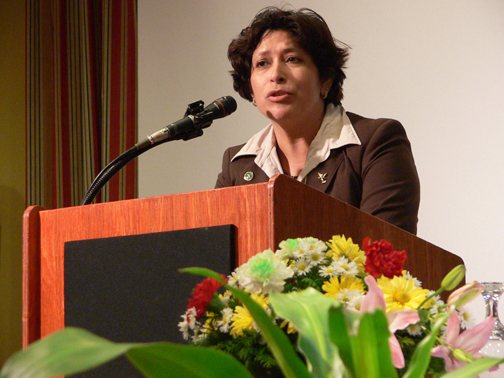
Protecting their namesake, Jaguar Cars (North America) established the Jaguar Conservation Trust to promote the preservation of the jaguar and its habitat. Actress, conservationist, and Jaguar Conservation Trust's lead consultant, Stefanie Powers presented grants to the Belize Audubon Society and Jaguar Shield. Jaguar Shield was awarded (US)$8,000, which will address problem jaguars in Belize. Accepting the award for the Belize Audubon Society was Executive Director Anna Dominguez-Hoare. The (US)$13,100 grant will be applied towards jaguar conservation and education at Cockscomb Basin Wildlife Sanctuary.

Friday, December 1

Youth and AIDS in the 21st Century

Heavy rains in Belize City did not stop bus-loads of youth from attending a World AIDS Day event. HIV/AIDS is an epidemic in Belize; the 2004 World Population Data Sheet indicates that outside of Africa, Belize has the sixth highest prevalence of HIV/AIDS in the world.

I heard about the event from a Peace Corps Volunteer who works with the Belize Red Cross. The Belize Red Cross was involved in the first national response and continues to participate in advocacy, providing information, training, technical assistance, food and clothing.
The Belize Red Cross, XChange/UNICEF, Ministry of Education, Youth for the Future, and National Art Development Foundation partnered with many other organizations organized a Youth Fest in Memorial Park. This year's theme:"Youth and AIDS in the 21st Century. Move On…". The Youth Fest featured performances from young people in the schools, youth organizations, and local musicians. All of the performances focused around the theme, to present positive messages, combat stigma and discrimination and disseminate accurate information about HIV and AIDS.

Thursday, November 30

Blogger meets YouTube

I'm introducing a new feature to my blog to bring Belize to life, embedded videos from YouTube. I can upload Quicktime movies from my digital camera. This first video clip is an experiment to see how well YouTube works with blogging. If all goes well, I'll share longer and better quality videos in the future. The original isn't as dark and pixelated, so there's plenty of room for improvement. This clip is a group of punta dancers from Dangriga. Enjoy.

Wednesday, November 29

Maya Centre Women's Group

Cockscomb Basin Wildlife Sanctuary was established in 1984 as a result of jaguar studies conducted in the area by Alan Rabinowitz. The boundaries were expanded in 1990 and again in 1997. Residents of Quam Bank, a Maya village within the boundaries of Cockscomb, were relocated to an new village (Maya Centre), but have preserved their traditional lifestyle. Maya Centre is located south of Dangriga on the Southern Highway and is the gateway to Cockscomb Basin Wildlife Sanctuary, seven miles down a red dirt road.

The Belize Audubon Society's advocacy program works with guardian communities, such as Maya Centre, to create a balance between the people and the environment. One result of community outreach is the Maya Centre Women's Group. If you visit Cockscomb Wildlife Sanctuary you will surely meet the friendly Women's Group, which sells entrance tickets. Through an agreement with the Belize Audubon Society, 10% of the sales go directly to the group. They also have colorful gift shop filled with traditional arts and crafts, such as slate carvings, wood carvings, jipijapa baskets, calabash, Mopan Maya clothing, and jewelry. Their website is really great and goes into more detail about the group and how crafts are made. In December I'm planning a computer training workshop for the Maya Centre Women's Group.

Tuesday, November 21

Garifuna Settlement Day

My weekend began with a three hour bus ride to Dangriga, with the same punta rock CD played over and over. In a weekend filled with the fast drum beating pulse of punta music, I heard everything from traditional Garifuna cadences to a rendition of The Farmer in the Dell blaring out of someone's balcony. Dangriga, the cultural center of the Garifuna people, is were I celebrated Garifuna Settlement Day on the 19th.

Also known as the Garinagu (plural) or Black Caribs, the people trace their history back to a group of African slaves who escaped two ship-wrecked Spanish slave ships near St. Vincent in 1635. St. Vincent was invaded by the British and the Garifuna were deported to Roata¡n in 1796 (an island off the coast of Honduras). The Garifuna fled Honduras in 1832 after a failed attempt to overthrow the Republican government. This mass migration to Belize is what the Garinfuna now celebrate on November19.

The party began early on Saturday with live music in the street and people all around. At night I went to PuntaFest with the group of Volunteers, too early apparently. The crowd was small and it sounded like the action outside the tent was much more exciting. Later that night we returned to a full crowd and danced the night away. To punta dance all you have to do is shake your hips profusely. I got a few hours of sleep, but the music and dancing never stopped.

At six in the morning we gathered around the bridge to watch a re-enactment. Three boats, decorated with palm leaves, appeared on the horizon of the sea and the drum beats grew louder as they paddled closer to shore. The Garifuna, in traditional dress carried cassava, plaintains, and other greens as they danced to drums. Once the boats landed the Garifuna started a procession to the Catholic church. The Garifuna practice of Catholocism is fused with their African beliefs, most evident to me was the lively music. The entire service was spoken in Garifuna. After mass I re-connected with the Volunteers enjoying more punta rock from a jukebox, where we also met a Garifuna woman with albino rats ( Jack and Jill) clinging to her shoulders as she danced.

In typical Belize fashion the parade started a few hours later than scheduled and at the end everyone started dancing behind the last float. After burning so much energy I found some traditional food being served under a tent. The conch soup with ground food was good. Again the festivities were as lively as the night before. Garifuna Settlement Day was a great time for me and I can still hear the rythm ringing in my ears. But what I really noticed was the cultural pride in the Garifuna and wanting to share that happiness with visitors.

Wednesday, October 25

Conch-fiscated


As we neared Half Moon Caye someone noticed a small doary within the protected area. When our boat approached, a young kid surfaced wearing snorkel gear and flippers. He had been diving for conch within the boundaries of the Natural Monument, which includes an extensive area of the surrounding atoll, fringing reef and lagoon, in addition to the island (about 9,700 acres). A sack of conch meat and their shells were confiscated by one of the BAS wardens. I couldn't understand their conversation in Spanish. Next, we motored over to the mainboat named Bob Marley. There was another cexchange in Spanish with that fisherman before we continued to Half Moon Caye. While the BAS wardens are responsible for patrolling the area, the Fisheries Department will follow-up with legal actions. I'm not sure how widespread poaching is in Belize. My impression, based on conversations with various Belizeans, is that fishermen are willing to accept the risk because effective patrolling is difficult for managers and the fines are not harsh enough. Further proof, this was not Bob Marley and the sailors' first appearance at Half Moon.

Traditional fishermen travel by sailboat to their destination. Then the fleet of doaries stacked in the mainboat are then taken out by the fishermen. Fishing is the 4th largest industry in Belize and conch is one of the most important products. The Queen Conch (Strombus gigas) is a large marine snail with a spiral-shaped shell and a beautiful pink lining. The meat is exported for commercial purposes (most to the U.S.) and the shells are crafted into art and jewelry. While overfishing is a concern, marine protected areas and management have sustained Belize's Queen Conch population so far. Through adaptive management, conch regulations have changed to include an off-season (which coincides with neighboring countries) and the Fisheries Department and management agencies can look at conch data to determine acceptable catch regulations.
Conch ceviche is a popular appetizer served with tortilla chips. Conch was out of season when I picked up the recipe, I had shrimp instead. Ceviche has many variations, but is basically a simple blending of fresh seafood and citrus juice, with the addition of vegetables and spices.
Ceviche
1 pound medium-small shrimp
2 Tbsp salt
3/4 cup lime juice (juice from 4-6 limes)
3/4 cup lemon juice (juice from 2-3 lemons)
1 sm-med. finely chopped red onion
1 lg. chopped tomato
1 cup chopped cilantro
1 cucumber, peeled diced into 1/2-inch pieces
1 habenero pepper minced (optional)
  1. Shell and devain shrimp (fresh seafood is a must).
  2. In a large pot, bring to a boil 4 quarts of water, salted
    with 2 Tbsp salt. Add the shrimp and cook for 1 minute to 2 minutes max, depending on size of shrimp. (Over-cooking the shrimp will turn it rubbery.) Remove shrimp with a slotted spoon and place into a bowl of ice water to stop the cooking.
  3. Drain the shrimp. Cut each piece of shrimp in half, or into inch-long pieces. Place shrimp in a glass or ceramic bowl. Mix in the lime and lemon juice. Cover and refrigerate for a half hour. Basically what's happening is the shrimp is "cooking" in the acidity.
  4. Strain and repeat washing, whis time adding in onions.
  5. Mix chopped vegetables in right before serving, salt and
    pepper to taste.
(P.S. -You can find more pictures of the recent trip to Half Moon Caye on my Flickr album)

Sunday, October 1

World Bird Festival

Many Belizeans awoke to the sounds of rain and thunder in Belize City, but not the early birds that joined the Belize Audubon Society in celebrating the World Bird Festival. October marks the beginning of a month-long event, initiated by BirdLife International, that connects people with nature. The Belize Audubon Society is a BirdLife Partner.

It wasn't easy for me to get up at 4:30 AM, but I am grateful that I did. In the darkness before sunrise I saw a Yellow-crowned Night-heron perched on a small vessel as we crossed the Swing Bridge. It was calm before the storm and the clouds shielded the suns rays; perfect conditions for birdwatching. A group of about 20 explored the birding hotspots in Belize City. Around the BAS office neighborhood we saw the typical city residents such as, Great-tailed Grackle, Clay-colored Robin, Tropical Mockingbird, and Great Kiskadee. Looking out upon the beautiful sunrise on the Caribbean Sea we saw the Magnificent Frigatebird, Brown Pelican, Laughing Gull, and Sandwich Tern. At the next two stops we picked up a few shorebirds, including the Semi-palmated Plover and Sanderling (pictured). In a vacant overgrown lot we saw orioles, warblers, flycatchers, and other passerines. We discovered many small niche communities throughout Belize City.


The last stop for the caravan of birdwatchers was a place called Birds Isle. By then the storm clouds had creeped all the way in from the sea. Even under the shelter we were able to see birds weathering the heavy rains outside. The streets were flooded when we drove back to our starting point and the rain continued throughout the rest of the afternoon. We tallied almost 60 species for the day.

Wednesday, September 20

Birding at Cockscomb

Cockscomb Basin Wildlife Sanctuary, one of the 9 protected areas that is managed by Belize Audubon Society, is well known as the world's first jaguar preserve. But instead of searching the trails for tracks of the elusive jaguar I was looking up for birds.

Israel Manzanero, the best kept secret of St. Herman's Blue Hole National Park, is an expert birder who works as a park warden for BAS. While I have a lot of past birding experiences to share, identifying the birds of Belize is new to me. I assisted Mr. Manza in teaching the warden's at Cockscomb how to improve their birding skills for monitoring and showing visitors around. There are a handful of common birds that can be identified easily, but 290 species have been recorded within the boundaries of the 128,000 acre wildlife sanctuary.

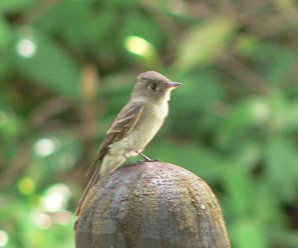
At around 5:15 AM we heard a Tropical Peewee while we enjoyed a hot cup of coffee on the verandah of our cabin; shortly afterwards, the call of a Spectacled Owl. At 5:30 AM the group met at the visitor center and by then the dawn chorus was at full volume. In the first hour I had a list of about 35 species. We hiked a trail to the riverside and looped back through the lowland jungle, covering a distance of about five miles. Before lunch, the list had grown to 82 species. I was so amazed by the quality of birding.

In the afternoon we hiked the Waterfall Trail to seek out some birds that live at higher elevation. My goal was to break 100 before the end of the day, but the afternoon was slower than the morning's activity. We returned to the visitor center and I continued gazing into the canopy, looking for the next new species. I located Black-faced Grosbeak and Yellow-winged Tanager among the many birds we had seen earlier. My list was now at 96 but it was too dark for my binoculars to gather enough light.

While chatting on the verandah after the sun had set, I heard an owl calling in the distance, identified by Mr. Manza as the Black and White Owl (97). We tried to relocate the Common Paraque we had seen the previous night but had no such luck. Then a heavy rain came down and persuaded me not to go on a night walk. It was difficult to sleep that night because one of the cabin mates was snoring as loud as a howler monkey. So I listened to the crickets calling, hoping to hear another owl in the forest, and waiting to do it all over again the next morning.


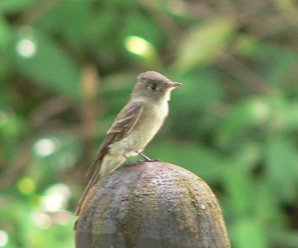
I don't know if we reached 100 as a group that day. Mr. Manza had at least one and maybe more birds that I had not seen or heard, so it's possible. However, I was not disappointed, never before I have I recorded so many bird species in such a short time. It was also pleasant to see a few visitor from home on their winter vacation, such as the Eastern Woodpeewee, Ovenbird, American Redstart, and Red-eyed Vireo. During my visit at Cockscomb I became familiar with a lot of new birds and their vocalizations so that when I'm on my own they won't give me much trouble.

Wednesday, September 13

Tapir Crossing

I have been waiting for a chance to see a wild tapir. While seeing a specimen at the Belize Zoo was exciting, it’s just not the same. However, my first encounter with a wild tapir came under sad circumstances. The other day Belize Audubon Society received a call about a tapir that had been hit by a vehicle at mile 9 of Belize’s Western Highway. While BAS has no jurisdiction over such wildlife issues, they are always willing to lend a hand to the Law Enforcement and Wildlife division of the Forest Dept. or the Belize Zoo. I went along with a staff member to the scene to help document what had happened. The large male tapir was dead on arrival and had a broken leg from the collision. We recorded an interview of a Belizean who had reported seeing the dead tapir on his way to Belize City in the morning. Other reports suggest that the tapir was alive earlier and that the animal suffered from heat stroke later. Residents from the nearby village of Hattieville knew that tapirs where present in this area. In fact, about three weeks ago another female tapir was hit on the road, but before any officials arrived to the scene it was gone. Apparently it was picked up and sold to villagers in the market.

Baird’s tapir (Tapirus bairdii), known as the mountain cow, is Belize’s national animal. The herbivorous animal is found where there is an abundance of successional flood-plain vegetation, which is a preferred food source of Baird's tapir. They are mostly solitary and are not very active during the day. Weighing in at 300-500 lbs, Baird’s tapir is the largest of the 3 American tapir species and the largest land mammal in Central America. Tapirs belong to the Order Perissodactyla (odd-toed ungulates), which includes horses and rhinoceroses. I surveyed the area and discovered a lot of tapir tracks and well worn trails. Obviously, this was not the first time the tapir had crossed the road.

Although Baird's tapir is categorized as Vulnerable, the species is considered endangered with extinction in most countries where it occurs. The main threats to tapir survival vary among different regions and different countries. Dominant forces affecting their populations are habitat loss and hunting. Tapirs are very susceptible to extinction because of their low reproductive rate. After a 13 month gestation period, the single young usually spends up to two years with its mother. This low recruitment rate coupled with hunting threats and habitat loss, is a serious factor contributing to Baird's tapir population decreases.

-IUCN Tapir Specialist Group

The story of this tapir may have been different if the driver had reported the accident. Fear may have been the reason why, because of the tapir’s protected status in Belize. When the story reaches the country on Channel 5 News, it is hopeful that drivers will be more cautious on the busy Western Highway.

Monday, September 11

St. George's Caye Day


St. George's Caye, nine miles offshore from Belize City, was the first capital city for the early British colonists (Baymen). On the 10th day of Spetember, 1798, the Baymen and their slaves defeated a Spanish invasion in the Battle of St. George's Caye. Today, Belize is the only country in Central America where English is the official language.

Today's event was celebrated with a parade and other festivities. More September Celebrations are on the way.

The Tenth Day of September (Song)

It was the 10th day of September
In ninety-eight Anno Domini
when our fore-fathers
won the glorious fight
at Old St. George's Caye
Hip! Hip! Hurrah. Hip! Hip! Hurrah.
Then hail them - cheer them.
Let our grateful loyal hearts not fail them,
as we march and sing and shout in merry glee
The Battle of St. George's Caye.
Hip! Hip! Hurrah. Hip! Hip! Hurrah.


Friday, September 8

Half Moon Caye


Recently, I had the opportunity to visit Half Moon Caye National Monument, which in 1928 became Belize's first protected area. I was on a boat with a few of the BAS staff members for about two hours before we reached Half Moon Caye of Lighthouse Reef. This was my first escape from the mainland. I saw a flyingfish gliding out of the beautiful waters of the Caribbean. Half Moon Caye is managed by Belize Audubon Society, along with the nearby Great Blue Hole. The shores are lined with coral rubble and white sand. On the eastern end of the island is an old lighthouse and coconut palms. The western end is a much more diverse in vegetation.


The Red-footed Booby (Sula sula) colony is one of the main reasons the natural monument was created. Half Moon's colony is unusual in the Caribbean context because of the almost complete dominance (98%) of the white, gold, and black adult color phase. An observation deck was built for visitors to view the colony in the canopy. The Magnificent Frigatebird (Fregata magnificens), which nest in the same Orange-flowered Ziricote thicket at the western end of the caye are also common.

Boobies and Frigatebids have an intersting realtionship on the island. Boobies frequently destroy the Frigatebird nests, while Frigatebirds feed on Booby eggs. The Red-footed Booby feeds by diving into the water for fish, while the Frigatebird, a poor diver, steals fish from the Booby. This behavior is depicted in the logo of the Belize Audubon Society.

Half Moon Caye a great place to bird watch because you don’t know what to expect. Nearly 100 species have been recorded here, 77 of these are migrants. I saw an osprey perched on a coconut palm and what I suspect was a yellow warbler.

The purpose of my visit to Half Moon was to introduce myself to the staff members and to look at how the small visitor center could be enhanced with exhibit signs. I can’t wait to return with some free time so I can explore more of the beautiful island diversity and the reef.

Friday, August 4

A Few Pictures From Belize

I spent the past week doing technical training with Environmental Education trainees in Armenia, a village south of Belmopan on the Hummingbird Highway. A women's group has established a program called Hummingbird Homestays, and so we each stayed with a host family. Part of our trainging included planning an environmental camp with a youth group for the younger children in the village. Armenia is a guardian community of St. Herman's Blue Hole National Park, which is comanaged by Belize Audubon Society. A guardian community refers to a commmunity that buffers a protected area.

My tech training group also visited various workers in the environmental field, such as park managers, tour guides, Belize Tourism Board, Belize Audubon Society, and Protected Areas Conservation Trust. We had some time for adventures such as hiking, birdwatching, and caving. Here are a few photos I shot this week. Plus I want to mention that I added a link to my flickr photo album where I have posted more pictures from Belize.


Wednesday, July 19

Site Assignment

The long awaited site assignments were revealed today. I am going to be in Belize City and will be working with the Belize Audubon Society (BAS) as a Programme Development Officer.

Belize Audubon Society is the oldest and largest conservation NGO in Belize. Through their mission BAS is "dedicated to the sustainable management of our natural resources through leadership and strategic partnerships with stakeholders in order to create a balance between people and the environment. " In collaboration with the Forest Department, BAS manages nine protected areas throughout Belize.

While Belize Audubon Society has worked with Peace Corps before, I will be their first Peace Corps Volunteer. The primary opportunities outlined for this project are to provide environmental education and community outreach support to BAS programs, parks, and communities through development of activities for kids' corner, developing education materials, implementing outreach activities to communities, the general public, schools, and BAS members. BAS also needs assistance with the development and writing of proposals for grants to support their work. I am very excited to have the opportunity to work Belize Audubon Society to say the least.

Saturday, July 15

Cassava Bread


The Peace Corps group took a bus ride on the Hummingbird Highway to the Stann Creek District of Belize. Our destination was the district capital Dangriga, located on the Caribbean Sea. First, we visited Gulisi Garifuna Museum to learn about the history and culture of the Garifuna people.


Garinagu (plural of Garifuna) or Black Caribs, are descendants of two ethnic groups, Carib Indians and Black Africans, that lived on the island of St. Vincent.
-National Garifuna Council


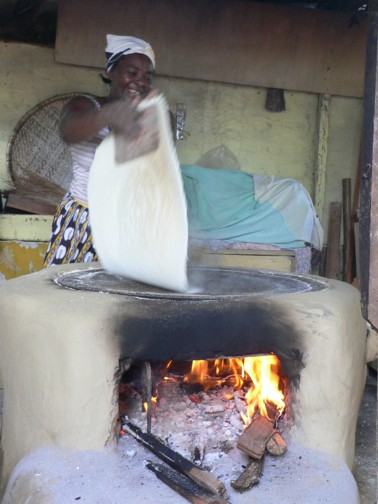
Next we visited a Naomi Noralez, who operates a cassava bread making business in Dangriga. Cassava bread is flat, round, biscuit-like, and very dry, so it has a long storage live if stored properly. We learned the traditional method and helped Miss Naomi make some cassava bread. It is a long process so I'll try to sum it up as best as possible. First, the tubers from the cassava plant are harvested, peeled and cleaned. The white tubers are then grated or mortared into a mash that is stuffed into a long woven snake-like basket called a ruguma, which is hung so the water can be strained out. Next the cassava is sifted into a flour through a round woven basket. The cassava flour is then spread onto a large griddle. It is packed down, more flour is sifted on and brushed. Then the whole piece is flipped over. If you think flipping a large pancake is difficult, try this. The edges are trimmed and the the bread is cut into sections, and there you have it, cassava bread!


Wednesday, July 12

Chaa Creek

Today the Environmental Education Trainees attended part of the Summer Teacher Institute workshop, which was put on with the help of two current Volunteers. Belizean and American teachers attended. The purpose of the project was to help teachers incorporate environmental education into primary schools of Belize. The major themes presented were ecology, archeology, and tourism in Belize. The program, which was a week long, was held at Chaa Creek, a private preserve and jungle lodge. It is an amazing place and has received numerous Ecotourism Awards.

We began the afternoon with a tour of the rainforest medicinal trail. Beautiful scenery, situated next to the Mopan River. Our naturalist guide Geovanni was an encyclopedia of knowledge, but I was easily distracted by the sight of a Blue Morpho (Morpho peleides). I had no luck photographing the butterfly, however it is the same as the animated one on my blog. A Mayan healer, Don Elijio Panti from the nearby village of San Antonio, was renowned for his knowledge of plants and herbs used in traditional medicine practice. The knowledge of Don Elijio was preserved when an American doctor, Rosita Arvigo began studying with him. Today Dr. Rosita continues traditional medicine and has her business close to my home in San Ignacio. In talking with my host family, natural medicine is still used and probably more so among the older generation. One relative in the family prefers traditional medicine over what his doctor prescribed for diabetes.

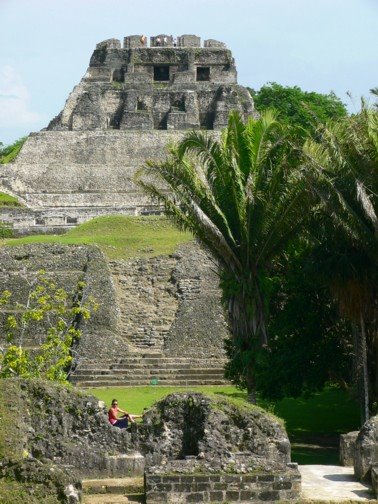
In addition to medicinals, the trees and plants have many other uses. I learned much about the Cohune Palm (Orbignya cohune) in an activity building session with the other teachers. We were asked to prepare something that could be used in the classroom after reading a short background article about the palm tree. My group performed a drama scene in which we transformed into a cohune palm and each presented a short dialogue about the different tree parts and their uses. The leaves are used for thatched roofs, the heart of the palm and the nuts are edible, the trunk is used in drum making, and etc. The cohune palm is probably the most important tree to the Mayans. Pictured here is the Mayan ruin Xunantunich, notice the large cohune palms on the right side.