Wednesday, July 19

Site Assignment

The long awaited site assignments were revealed today. I am going to be in Belize City and will be working with the Belize Audubon Society (BAS) as a Programme Development Officer.

Belize Audubon Society is the oldest and largest conservation NGO in Belize. Through their mission BAS is "dedicated to the sustainable management of our natural resources through leadership and strategic partnerships with stakeholders in order to create a balance between people and the environment. " In collaboration with the Forest Department, BAS manages nine protected areas throughout Belize.

While Belize Audubon Society has worked with Peace Corps before, I will be their first Peace Corps Volunteer. The primary opportunities outlined for this project are to provide environmental education and community outreach support to BAS programs, parks, and communities through development of activities for kids' corner, developing education materials, implementing outreach activities to communities, the general public, schools, and BAS members. BAS also needs assistance with the development and writing of proposals for grants to support their work. I am very excited to have the opportunity to work Belize Audubon Society to say the least.

Saturday, July 15

Cassava Bread


The Peace Corps group took a bus ride on the Hummingbird Highway to the Stann Creek District of Belize. Our destination was the district capital Dangriga, located on the Caribbean Sea. First, we visited Gulisi Garifuna Museum to learn about the history and culture of the Garifuna people.


Garinagu (plural of Garifuna) or Black Caribs, are descendants of two ethnic groups, Carib Indians and Black Africans, that lived on the island of St. Vincent.
-National Garifuna Council


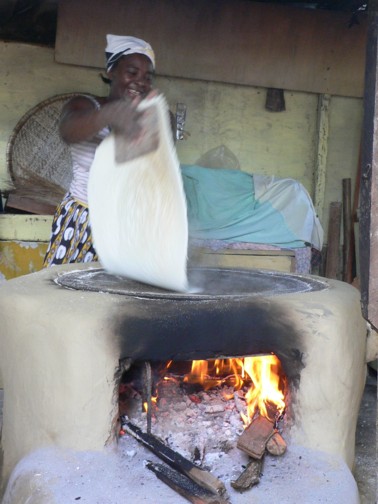
Next we visited a Naomi Noralez, who operates a cassava bread making business in Dangriga. Cassava bread is flat, round, biscuit-like, and very dry, so it has a long storage live if stored properly. We learned the traditional method and helped Miss Naomi make some cassava bread. It is a long process so I'll try to sum it up as best as possible. First, the tubers from the cassava plant are harvested, peeled and cleaned. The white tubers are then grated or mortared into a mash that is stuffed into a long woven snake-like basket called a ruguma, which is hung so the water can be strained out. Next the cassava is sifted into a flour through a round woven basket. The cassava flour is then spread onto a large griddle. It is packed down, more flour is sifted on and brushed. Then the whole piece is flipped over. If you think flipping a large pancake is difficult, try this. The edges are trimmed and the the bread is cut into sections, and there you have it, cassava bread!


Wednesday, July 12

Chaa Creek

Today the Environmental Education Trainees attended part of the Summer Teacher Institute workshop, which was put on with the help of two current Volunteers. Belizean and American teachers attended. The purpose of the project was to help teachers incorporate environmental education into primary schools of Belize. The major themes presented were ecology, archeology, and tourism in Belize. The program, which was a week long, was held at Chaa Creek, a private preserve and jungle lodge. It is an amazing place and has received numerous Ecotourism Awards.

We began the afternoon with a tour of the rainforest medicinal trail. Beautiful scenery, situated next to the Mopan River. Our naturalist guide Geovanni was an encyclopedia of knowledge, but I was easily distracted by the sight of a Blue Morpho (Morpho peleides). I had no luck photographing the butterfly, however it is the same as the animated one on my blog. A Mayan healer, Don Elijio Panti from the nearby village of San Antonio, was renowned for his knowledge of plants and herbs used in traditional medicine practice. The knowledge of Don Elijio was preserved when an American doctor, Rosita Arvigo began studying with him. Today Dr. Rosita continues traditional medicine and has her business close to my home in San Ignacio. In talking with my host family, natural medicine is still used and probably more so among the older generation. One relative in the family prefers traditional medicine over what his doctor prescribed for diabetes.

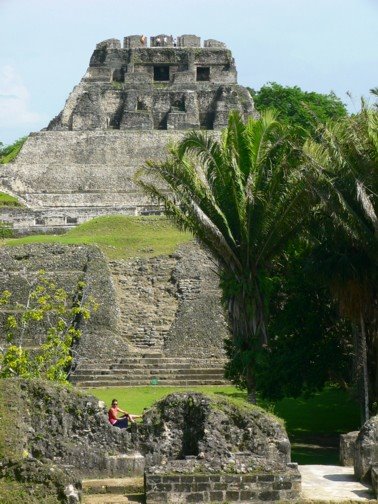
In addition to medicinals, the trees and plants have many other uses. I learned much about the Cohune Palm (Orbignya cohune) in an activity building session with the other teachers. We were asked to prepare something that could be used in the classroom after reading a short background article about the palm tree. My group performed a drama scene in which we transformed into a cohune palm and each presented a short dialogue about the different tree parts and their uses. The leaves are used for thatched roofs, the heart of the palm and the nuts are edible, the trunk is used in drum making, and etc. The cohune palm is probably the most important tree to the Mayans. Pictured here is the Mayan ruin Xunantunich, notice the large cohune palms on the right side.

Monday, July 10

Mengo Time


There are two mango trees in my host family's backyard and they're delicious. This Kriol song is the un-official national anthem for Peace Corps Belize...

Mengo Time

Mi noh kyaa weh dehn seh, Mengo time
Ah geh mi baaskit ahn krokas beg
Ahn tie mi hed wid eny ole reg
Mengo time, mengo time, mengo time

Mango Time

I don't care what they say, Mango time
I get my basket and crocus bag
And tie my head with any old rag
Mango time, mango time, mango time

Saturday, July 8

Iguana Project

I recently visited a project in my host town of San Ignacio, in the Cayo District, that is helping to educate and conserve Belize's largest lizard the green iguana (Iguana iguana). Behind the San Ignacio Hotel is a small screened building filled with tropical plants and iguanas. The project incubates iguana eggs that have come from disturbed nests, raises them to maturity, and releases them into the wild. Sex determination is dependent on temperature; if the temp is below 82 they will be females and above 95 will be males. The incubation period is about 3 months and they reach maturity at about 2 years. When they are released, a few of the soft spines on the back are clipped so they can be easily identified during surveys.

I saw a wild iguana basking on a log in the Mopan River, on July 4th, when our training group visited a Mayan ruin called Xunantunich. But their population has declined because of hunting. Iguana meat is a delicacy, also known as bamboo chicken. The iguana's eggs are also a delicacy. Although the iguana is now a protected species, I was told they may be seen in the Belize City market and are available in the black market. Enforcement can be difficult because the bush meat comes from rural areas of Belize. Large females with eggs are the most sought after. Smaller iguanas may be captured for the pet trade.

While a green iguana, as large as 7 feet head to tail, may seem scary to some people, it is nothing to be feared. They have sharp teeth and claws but adults are strictly herbivorous. For defense they can display their dewlap, which has sub-tympanic discs that mimic large eyes in order to fool predators. Iguanas are also capable of loosing their tail (autotomy) for defense and it will regenerate. Another interesting tidbit, which I did not know about iguanas, is that they have a third eye on the top of their head that can detect light and dark.

Monday, June 19

New Staging Date

The new staging event is scheduled for June 24-25 in Washington D.C. I pray this will be the last delay in what has become a very testing experience to begin Peace Corps.

Friday, June 9

Staging Delayed

I received a call from Peace Corps yesterday and was informed that my program departure is being moved back a few weeks due to a logistical problem.

Wednesday, May 24

Blog Makeover

A lot has changed since my adventures in Madagascar ended and now I would like to introduce you to the new style of my blog.

The new title still seems a bit odd and I haven't got used to it yet. Tata Duhendeh is a mythical short man who lives in the bush, his feet are backwards and he has no thumbs. In folklore, the Belizeans say he is a forest guardian and trickster. He will punish people for over-hunting, taking Mayan artifacts, or causing mischief in the bush. However, Tata Duhendeh is not portrayed as an evil character, he will rescue people in the forest or teach you to play guitar as a reward.

For frequent visitors or anyone interested about updates on this page, I have added a tracking feature called Blogarithm. By clicking on the Blogarithm button, located in the right column you will be directed to a new page. Enter your email address and click. After a simple, two-step process to confirm your email address and select a password, the subscription is complete. You will receive an email when a new post is published. Much easier than bookmarks and you won't have to waste time checking the page to find nothing new.

Finally, I have added web-links to great sites with information related to Belize. Enjoy the new site and feel free to leave comments or suggestions.

Monday, May 22

One Small Step for Man...

The United Nations proclaimed May 22 The International Day for Biological Diversity (IBD) to increase understanding and awareness of biodiversity issues. This year The Convention on Biodiversity is promoting the protection of biodiversity in drylands.

In addition to an official celebration of International Biodiversity Day in Belize, organizations within Belize are putting on the 2nd Annual Natural Resources and Environment Week, May 21st to 27th. This year's theme is "Environmental Education- A Step Towards Friendly Development".

And that's where I come in, serving as an Environmental Educator. I will be helping Belizeans to manage natural resources and protect biodiversity in sustainable ways that accrue benefits to community members and improve their quality of life. It sound like a lot of responsibility, but I will take small steps and at the same time learn about the environment from Belizeans. Together we will make the world a better place.

Friday, May 5

Land of the Free by the Carib Sea!


Some facts and information about Belize...

Capital: Belmopan
Population: 273,700
Land Area: 8,876 sq mi

National Bird: Keel-billed Toucan
National Animal: Baird's Tapir
National Flower: Black Orchid
National Tree: Mahogeny

Belize is located in Central America; bound by Mexico in the north, Guatemala on the west and south, and 174 miles of Carribean coastline on the east. The land area of the mainland and cayes is 8,867 square miles; roughly the size of Massachusetts. The population is estimated to be 273,700; comparable to the population of St. Paul, Minnesota. Massachusetts has about 6.5 million people. The ethnic groups include Creole, Garifuna, Mestizo, Spanish, Maya, English, Mennonite, Lebanese, Chinese, and East Indian. Belize was a British colony, formerly known as British Honduras. English is the official language; Creole and Spanish are also commonly spoken. Agriculture (sugar, citrus, and bananas), tourism, fisheries, and forestry play a major role in the economy of Belize.


With 40% of it's territory designated as protected areas, Belize has the highest percentage in the world. Belize has a wealth of natural resources, icluding pristine forests, coral reefs, natural monuments, archaeological reserves, private and public land and a diversity of fauna and flora. The are 51 parks and forest reserves, 8 recognized private protected areas and 9 archaeological reserves, 11 marine reserves, and 12 marine spawning agregations.

"From the soft adventure novice to the hard adventure enthusiast, Belize is a paradise on earth. Hike through exotic jungle trails... tube along an underground river... explore the brilliant depths of a magnificent barrier reef... Belize can satisfy the adventurer in all of us. Adventure into a land rich in natural beauty and steeped in the magic of its Maya past. Renowned for pristine waters, exotic marine and wildlife, lush, unspoiled landscapes, and superb diving, Belize is Mother Nature's Best Kept Secret. Natural and unspoiled, Belize is a haven for some of the planet's most exotic and endangered species. It has become a recognized leader in preservation and conservation, where nature reserves abound, and a fascinating population of birds, beasts, and marine life reside."
-BELIZE TOURIST BOARD (www.travelbelize.org)

Thursday, May 4

Mother Nature's Best Kept Secret!

Here's a brief description of the new assignment I received from Peace Corps.

Country: Belize
Program: Community Conservation
Job Title: Environmental Educator
Dates of Service: Aug. 4, 2006- Aug. 3, 2008

The goal of this project is to promote initiatives of Belizean community members and organizations for the conservation of land and natural resources. The project works with community members to find opportunities where conservation can be partnered with income-generating activities. The project also provides support in increasing environmental awareness through the development and implementation of environmental education, both formal and non-formal.

The Peace Corps was founded in 1961 by John F. Kennedy and is guided by three goals:

*To help the people of interested countries in meeting their needs for trained men and women.

*To help promote a better understanding of Americans on the part of the peoples served.

*To help promote a better understanding of other peoples on the part of all Americans.

Saturday, March 4

To the Otherside of the World and Back

Not long after I arrived to the training post in Madagascar I received a notice of medical seperation. If you want a longer explanation and did not receive my email let me know. Before leaving Madagascar I captured some great photos, although it is simply a representation of everyday life in Madagascar. Time was so short that I did not have an opportunity to explore protected areas, to see lemurs, or anything of really wild nature. Now I am waiting patiently for a new volunteer assignment from the Peace Corps, hopefully close enough to make a return visit to Madagascar possible in my future.


View from PC Training Center


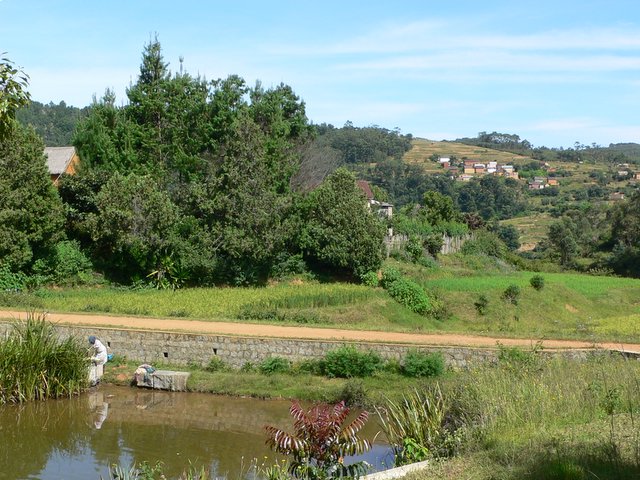
Malagasy woman doing laundry


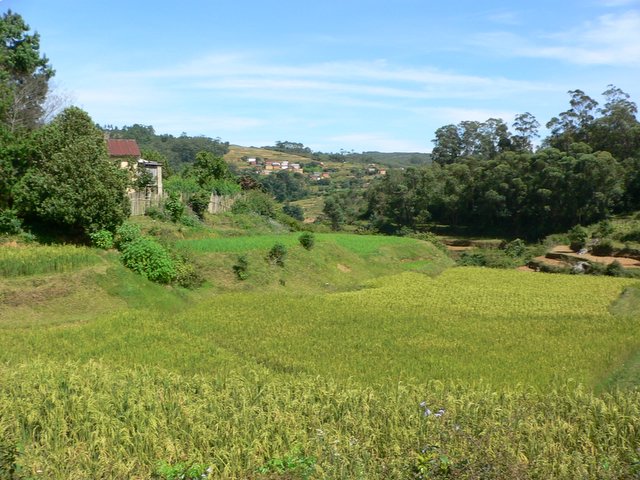
Terraced agricultural landscape.


Comet orchid (Angraecum sesquipedale)
Posted by Picasa

Tuesday, February 14

Staging

Staging in Phili is done. Shortly I will be going to the airport and flying to Africa. I am one of 21 new Volunteers who will be working on the Environment Project in Madagascar. During the 3 month training session I will have no Internet access, so it will be a while before I will be able to provide any updates.

Saturday, January 21

Makira Protected Area

The Wildlife Conservation Society (WCS) recently announced the establishment of a new protected area in Madagascar. To read the full article and for more information visit the following sites:

www.wcs.org/353624/madagascarsnewprotectedarea
www.wcs.org/international/Africa/madagascar/makira

For me this new found information has provided a better understanding of my duties as a Peace Corps Volunteer. Until now my assignment as a Protected Areas Management Volunteer seemed a little vague. The idea of working on natural resource management activities in rural communities near protected areas has left me wondering about the innumerable possibilities I could face in the future. It is encouraging to see a concrete example of protected area management in Madagascar that is in line with my assignment and how it will benefit both the community and natural resources. The site will be co-managed by WCS and the Ministry of Environment, Water and Forests (MINEF). As a PCV my primary duty is to meet the needs of MINEF and other partner organizations. The new Protected Areas System was designed to involve local communities in natural resource management.

Whether or not I will be assigned to work in this particular area of Madagascar, I don't know. Makira Protected Area is one of five newly established protected areas, with more sure to follow. President of Madagascar Marc Ravalomanana has committed to increasing the total area protected from 1.7 million to six million hectares by 2008.

Monday, December 12

Assignment

Here some details from the assignment booklet I recieved and additional comments on the environmental health of Madagascar

Country: Madagascar
Program: Environment Project
Job Title: Protected Areas Management Volunteer
Dates of Service: April 2006-May 2008

The first Peace Corps program in Madagascar began in 1993 and to this date 514 volunteers have served there. The environment sector was established in 1994 with the following goals,

to reduce degradation of natural resources, develop capacity of local individuals and institutions, and enhance management capabilities of responsible government officials and non-government organizations.


Madagascar is one of the world's top hotspots for biodiversity, In Madagascar 80% of the plants and animals are endemic, that is they are found nowhere else on earth.

To qualify as a hotspot, a region must meet two strict criteria: it must contain at least 1,500 species of vascular plants (> 0.5 percent of the world’s total) as endemics, and it has to have lost at least 70 percent of its original habitat (www.biodiversityhotspots.org).

While Madagascar is one of the world's richest areas of biodiversity, economically it is one of the poorest. It is primarily an agrarian society where "nearly 80% of the original forestland has been converted into agriculture land." Environmental degradation has resulted from unsustainable agricultural practices, such as slash and burn agriculture practiced by rice farmers, which lead to deforestation, soil erosion, and decreased fertility.

Currently Madagascar has 46 protected areas which are managed by the Association Nationale pour la Gestion des Aires Protégées (ANGAP) and the Ministère des Eaux et Forêts (MINEF). ANGAP is the National Park Service equivelent, whereas MINEF is more like the USDA-Forest Service, which allows sustainable resource use. However, the goal of the MINEF is to allow the local communities to manage their resources.

Thursday, December 8

Ho eny Madagasikara aho!

I've created this blog in hopes of keeping family and friends updated on my adventures in Madagasar, where I have been invited to serve as a Protected Areas Management Volunteer for the Peace Corps. It all sounds good in theory, but I don't know how often I will be able to access the internet to update this site. Even if its one posting per month, I think the result will be more efficient and organized than mailing letters home.

If you have any questions realated to Madagascar and my journal entries please post them under the comments and I will respond. You may also contact me by email at scott_w_schmidt@yahoo.com.

"Ho eny Madagasikara aho" is the Malagasy phrase for "I'm going to Madagascar." A good reference site is http://www.wildmadagascar.org/.